
Chimney Crown Repair Cost in Buffalo, NY: $150–$2,800 Depending on Damage
Chimney Cap & Crown services in Buffalo typically run $150–$400 for surface sealing, $400–$900 for structural crack repair, and $1,200–$2,800 for full crown replacement on a standard single-flue chimney. The exact cost depends on how far the freeze-thaw cycle has already traveled from that first hairline crack. Call (833) 632-3568 for a free on-roof inspection and exact quote — Thomas Hernandez handles every estimate personally.
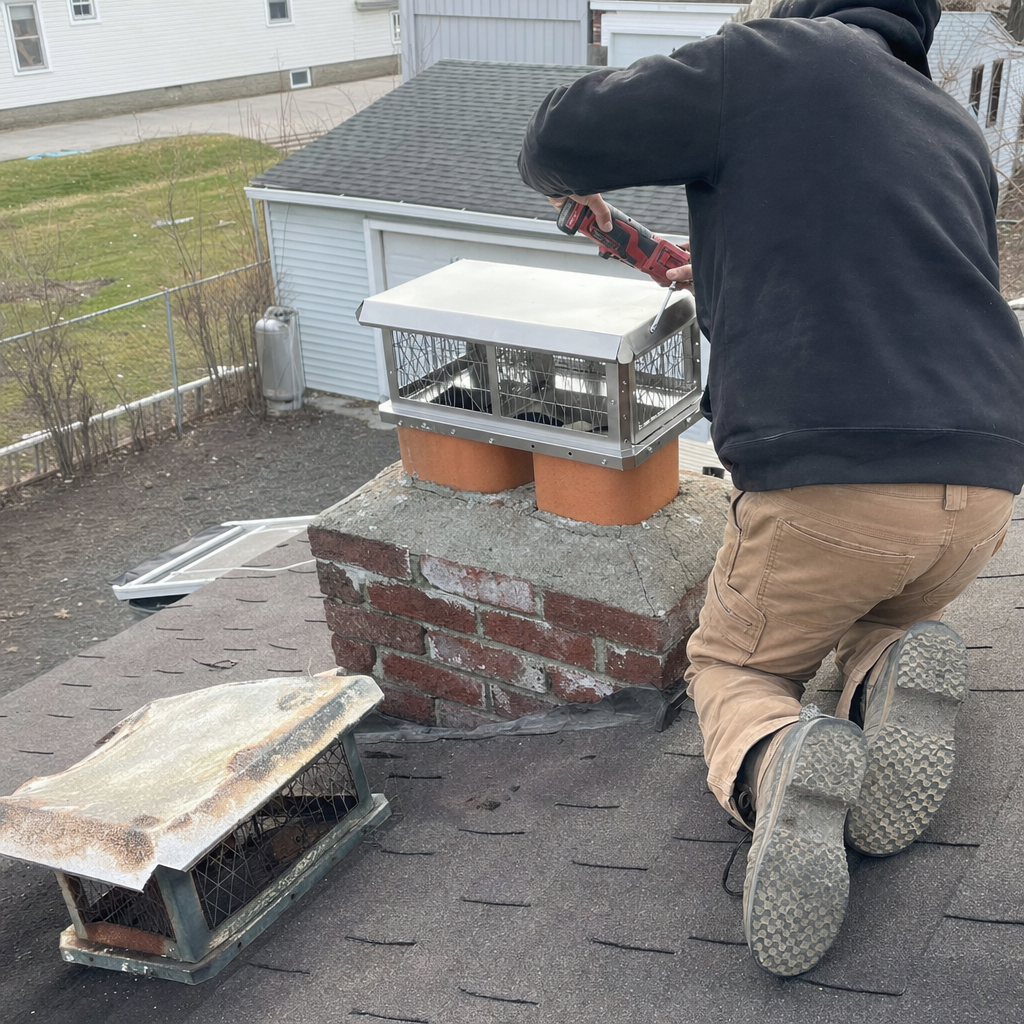
Thomas Hernandez walks off more Buffalo roofs in April having found cracked chimney crowns than any other single problem. Every one of them started as a hairline crack the previous fall. Here’s what fixing it costs before it turns into a $4,000 problem.
Buffalo’s position directly downwind of Lake Erie subjects its overwhelmingly pre-WWII masonry chimneys to among the most punishing freeze-thaw cycling of any major U.S. city. Wet lake-effect snow repeatedly saturates mortar joints that then refreeze — accelerating spalling and crown deterioration far faster than in neighboring Rochester or Erie. For Buffalo homeowners, annual chimney cleaning is inseparable from structural masonry inspection and Best Chimney Cap & Crown in Buffalo, NY evaluations, because a chimney that passed visual scrutiny in October can have open mortar joints and cracked crowns by April.
Why Crown Repair Is the Highest-Leverage Dollar You’ll Spend on Your Chimney
We’re not being dramatic when we say this: a proper crown repair is 3–5% of what a full rebuild costs, but most homeowners don’t hear that framing until after the damage is done.
Here’s the sequence we see every spring. Lake-effect events drop 2–3 feet of wet, heavy snow on Buffalo in 24–48 hours. That snow packs against the chimney crown, finds a hairline crack — sometimes barely visible to the naked eye — and saturates the concrete. Temperature swings through 80–100 freeze-thaw cycles per season lever that crack open like a wedge. Water enters the brick course below, freezes again, and spalls the face off the brick. By April, we’re looking at crown repair plus masonry repointing plus potential flue liner damage from moisture intrusion.
In October, that repair might have been a $250 sealant application. In April, it’s often $1,800–$4,000 in combined work. The crown is your chimney’s umbrella. When it fails, everything beneath it gets wet, freezes, and degrades.
Thomas grew up on Buffalo’s West Side, a few blocks from Olmsted’s Delaware Park, and never strayed far. He learned building systems through the HVAC and construction technology program at Erie Community College’s North Campus, then spent his early years shadowing veteran tradespeople until chimneys became his focus. For the past 11 years he’s run Titan Chimney Cleaning across Greater Buffalo. His dad heated their childhood house with a wood stove, which is probably why a blocked flue feels personal — not just a service call.
Buffalo Chimney Crown Repair Cost Breakdown by Damage Level
Not every cracked crown needs the same fix. We price by what we find on the roof, not by what a call-center script says to quote. Here’s how the three repair levels break down for Buffalo’s typical masonry chimneys:
| Repair Type | What It Fixes | Typical Cost in Buffalo |
|---|---|---|
| Surface sealant (CrownCoat / elastomeric) | Hairline cracks, surface crazing, minor spalling — crown structure still sound | $150 – $400 |
| Structural crack repair (mortar rebuild + reinforcement) | Active cracks with separation, minor deterioration at edges, early brick exposure | $400 – $900 |
| Full crown replacement (formed concrete or precast) | Extensive cracking, crumbling, missing sections, or crown slope failure causing ponding | $1,200 – $2,800 |
| Crown + masonry repointing (combined repair) | Crown failure with downstream brick damage — common in Buffalo after harsh winters | $1,800 – $4,500 |
These ranges assume a standard single-flue residential chimney on a Buffalo-area home built during the city’s peak growth era — roughly 1880–1930. Multi-flue chimneys, steep roofs requiring specialized access, or chimneys with significant height above the roofline can push replacement costs toward the higher end. We see a lot of those original multi-flue masonry chimneys across the East Side, Elmwood Village, and South Buffalo — most built for coal furnaces later converted to oil or gas, leaving oversized flue liners that complicate crown geometry and repair access.
What Distinguishes Each Damage Level (So You Know What You’re Paying For)
We’re not going to sell you a full replacement for surface crazing, and we’re not going to sealant-over a structurally failed crown just to hit a lower price point. Here’s what Thomas looks for on your roof:
- Surface sealant level: Cracks you can see but can’t fit a dime into. The crown still sheds water properly. No exposed aggregate or crumbling. This is preventive maintenance — the sweet spot where a $200–$300 application of professional-grade elastomeric sealant buys you years.
- Structural repair level: Cracks with visible separation, edge deterioration where the crown meets the brick, or minor spalling that exposes the inner matrix. We grind back to sound material, apply reinforcement where needed, and rebuild with proper bonding agents. This isn’t a surface coat — it’s surgical repair.
- Full replacement level: Missing chunks, through-cracks that let light into the flue chase, or a crown that’s flat or reversed-slope (ponding water instead of shedding it). At this stage, the crown has failed structurally and is actively destroying everything below it. Replacement means forming and pouring new concrete with proper slope, drip edge, and reinforcement — or installing a precast replacement with equivalent specifications.
The southtowns — Orchard Park, Hamburg, West Seneca — get hit hardest. Those areas exceed 150 inches of snow annually, and the lee faces of chimneys in the snowbelt pack with wind-driven snow that accelerates the saturation-freeze cycle. Spring inspections after a typical Buffalo winter frequently reveal frost-heaved caps and open horizontal mortar beds that didn’t exist the prior fall. If you’re south of the city, your crown is working harder than almost any chimney in the country.
The DIY Crown Sealant Trap (And What Professional Repair Actually Costs)
Every spring, Thomas finds crowns that a homeowner hit with a $40 bucket of big-box sealant the previous fall. The sealant looks fine from the ground — maybe even lasted the winter without peeling. But underneath, moisture was still entering through structural cracks, and the sealant trapped it there. Accelerated failure. Now we’re looking at full replacement instead of a $250 sealant job.
The problem isn’t the product category — it’s the application context. Consumer-grade sealants applied over unprepared, structurally compromised concrete create a vapor barrier in the wrong direction. Professional-grade crown repair materials from suppliers like Copperfield and Famco are formulated for chimney-specific thermal cycling and bond properly when the substrate is correctly prepared. But the preparation matters as much as the product: grinding back to sound concrete, addressing active cracks with proper reinforcement, ensuring the crown slope is corrected so water doesn’t pond.
That’s why Thomas is on every job. The repair scope gets determined by what he finds on your roof, not what a call-center booker quoted over the phone. We’ve turned down jobs where a homeowner wanted us to “just seal it” over structural failure — if I wouldn’t let my own family light that fireplace, I’m going to tell you straight.
Professional crown sealant application with proper prep typically runs $150–$400 in the Buffalo market. The difference between that and the $40 DIY bucket is: diagnosis of whether sealant is even appropriate, substrate preparation, product specification for your specific crown material and exposure, and application technique that ensures bond and proper thickness. On a Buffalo chimney facing 80–100 freeze-thaw cycles annually, that’s not cosmetic — it’s structural insurance.
What a Full Crown Replacement Includes (And Why It Costs What It Costs)
When the crown is beyond repair, replacement is the only option that stops the damage cascade. Here’s where your money goes:
Labor and access: Safe roof access on Buffalo’s pitched roofs, especially on Victorian-era homes with complex rooflines, requires proper fall protection and often specialized equipment. The crown itself may be 15–25 feet above grade, with the actual flue terminal higher still.
Demolition and disposal: Removing the failed crown without damaging the brick course beneath requires controlled breaking and careful extraction. We haul away all debris — not always a given with lower-tier operators.
Forming and reinforcement: A proper replacement crown is formed in place with adequate slope (minimum 3:12, though we prefer steeper for Buffalo exposure), a drip edge that directs water clear of the brick face, and steel reinforcement to handle thermal expansion. The thickness at the center typically runs 4+ inches, tapering to the edges.
Material specification: We use professional-grade concrete mixes and bonding agents suited to chimney exposure — not standard bag mix that’ll spall within a few seasons. For certain applications, we work with Olympia Chimney and DuraFlex components where liner integration or cap coordination is part of the scope.
Curing and weather protection: In Buffalo’s variable spring and fall weather, proper curing is critical. We schedule around forecast windows and use curing compounds or protective covering as needed.
Affordable Chimney Cap & Crown in Buffalo, NY full replacement on a typical single-flue chimney runs $1,200–$2,800. The wide range reflects chimney size, access difficulty, and whether we’re also addressing damage that has already propagated to the brick course below.
The Real ROI: Crown Repair Versus Rebuild
We want to give Buffalo homeowners a number that makes the decision clear.
A $150–$400 crown sealant done correctly stops the freeze-thaw entry point. The alternative — letting it go — leads to $2,000–$6,000 in masonry repointing, flue liner repair or replacement, and potentially interior damage from water intrusion. We’ve replaced liners in Allentown homes where the root cause was a $200 crown crack that went unaddressed for three winters. The homeowner paid fifteen times the preventive cost.
Even a $1,200–$2,800 full crown replacement is roughly one-third to one-half the cost of a partial chimney rebuild, and a small fraction of a full rebuild with liner replacement. The crown is the highest-leverage maintenance point in your entire chimney system because it’s the first line of defense against the single factor that destroys Buffalo chimneys: water entry followed by freeze-thaw cycling.
Nearly 300 homeowners have trusted us across 11 years in this single trade. Our 297 verified reviews at a 4.7-star average reflect what happens when the same technician who answers your call also climbs your roof and stands behind the work. We’re not a franchise rotating crews — Thomas shows up personally, and the repair scope is determined by what he finds, not what a dispatcher needs to book.
Our Chimney Cap & Crown in Buffalo service covers the full scope of crown and cap work, from inspection through replacement. If you’re unsure which damage level you’re facing, that’s exactly what an inspection is for.
When to Schedule Crown Inspection in Buffalo
Timing matters for both diagnosis and repair scheduling.
Fall (September–October): Ideal for preventive sealant applications. The crown is dry, temperatures are moderate for proper curing, and you’re sealed before the first lake-effect event. This is when we catch hairline cracks and stop the sequence before it starts.
Spring (April–May): Necessary if you suspect winter damage. We can assess how far the freeze-thaw cycle has progressed and scope repairs before the next heating season. Spring bookings fill fast because every chimney in Buffalo that took a beating shows up at once.
After major lake-effect events: If you’ve had 2+ feet of wet snow against the chimney, or if you notice new interior staining, efflorescence on the brick face, or debris in the firebox, schedule an inspection. After major dumps, we regularly find flue openings and chimney caps packed solid with wind-driven snow and ice — blocking combustion gases and creating carbon monoxide backdraft conditions. It’s a failure mode virtually unknown in most of the country but a recognizable seasonal pattern here, particularly on the lee faces of chimneys in the southtowns snowbelt.
Waiting until you see interior water damage means the crown has already failed structurally and water has traveled through the masonry. At that point, you’re past the cost window where simple repair suffices.
FAQs
Chimney crown repair in Buffalo costs $150–$400 for surface sealing, $400–$900 for structural crack repair, and $1,200–$2,800 for full replacement on a typical single-flue chimney. The exact price depends on crown size, access difficulty, and how far damage has spread to the brick below. Call (833) 632-3568 for a free on-roof estimate — Thomas Hernandez evaluates every job personally.
Repair is dramatically cheaper when caught early — a $150–$400 sealant application versus $1,200–$2,800 for full replacement. However, structural cracks or crumbling crowns can’t be sealed cost-effectively; replacement becomes the only option that stops ongoing damage. The real cost comparison isn’t repair versus replacement — it’s timely repair versus deferred maintenance that leads to $2,000–$6,000 in combined masonry, liner, and interior repairs. If you’re unsure which category your crown falls into, an inspection removes the guesswork.
Surface sealant applications can often be completed same-day if weather permits and the crown is dry enough for proper bonding. Structural repairs and full replacements require scheduling based on material curing requirements and weather windows — we won’t rush a cure in Buffalo’s variable conditions just to check a box. Thomas carries the equipment and materials for common sealant jobs on his truck, so if your crown qualifies and conditions are right, you’ll have protection before the next forecast. Call (833) 632-3568 to check same-day availability.
Buffalo’s lake-effect snow and extreme freeze-thaw cycling destroy crowns faster than almost anywhere in the country. Wet, heavy snow saturates hairline cracks, then 80–100 annual freeze-thaw cycles lever those cracks open and admit water into the brick course below. A chimney that passed inspection in October often shows open mortar joints and cracked crowns by April. This isn’t a maintenance schedule issue — it’s a climate reality for pre-WWII masonry chimneys in one of the most punishing freeze-thaw environments of any major U.S. city. Annual inspection is essential here, not optional.
Get Your Buffalo Chimney Crown Inspected Before the Next Freeze Cycle
Every chimney crown Thomas has replaced in Buffalo started as a smaller problem that grew through one or two winters of inaction. The $200 fix became the $2,000 fix became the rebuild. We’re not interested in selling you work you don’t need — we’re interested in catching yours at the stage where a straightforward repair protects everything below it for years.
Call (833) 632-3568 to schedule your free crown inspection. Thomas Hernandez will walk your roof, show you what he’s seeing, and give you a straight answer on whether you’re looking at sealant, repair, or replacement — no call-center filter, no surprise upsells, just 11 years of chimney-only experience applied to your specific situation.
Written by Thomas Hernandez, Owner & Lead Technician at Titan Chimney Cleaning Greater Buffalo, serving Buffalo, NY.