
Last updated July 15, 2026
Chimney Cleaning Permits, Codes & Inspections in NY: What You Need to Know
Here’s a scenario that plays out more often than you’d think in Buffalo’s real estate market: a homeowner sells their Elmwood Village colonial, the buyer’s inspector runs a camera up the flue, and discovers the chimney liner was replaced three years ago with zero permit on file. The sale stalls. The seller — not the contractor who did the work — eats the cost of a re-inspection, possible re-work, and weeks of delay. In our 11 years of cleaning and repairing chimneys across Buffalo, we’ve seen this exact situation four times. Most homeowners assume their contractor handled the paperwork. Most are wrong. This guide — alongside our The Complete Guide to Chimney Cleaning in Buffalo — breaks down which chimney jobs actually require permits under New York State and Buffalo code, who’s responsible for pulling them, and why the paper trail matters for your safety, your insurance, and your home’s resale value.
Quick Answer
In New York State, chimney cleaning and routine maintenance typically do not require permits, but chimney repairs involving structural changes, liner replacements, or full rebuilds do require building permits under the NYS Residential Code. Buffalo enforces these rules through the City of Buffalo Permit Office, with additional fire safety inspections required for solid-fuel appliance installations. Homeowners, not contractors, are often held liable for unpermitted work when selling or filing insurance claims.
Table of Contents
- Which Chimney Jobs Require Permits in New York State?
- How Buffalo and Erie County Codes Work Together
- NFPA 211 vs. New York State Enforcement
- What a Code-Compliant Inspection Looks Like After a Liner Installation
- Permit Responsibility: Contractor vs. Homeowner
- Why the Paper Trail Matters for Insurance and Resale
- Common Mistakes to Avoid
- When to Call a Professional
- Frequently Asked Questions
Which Chimney Jobs Require Permits in New York State?
Not every chimney service triggers a trip to the permit office. Understanding the line between maintenance and modification saves you from unnecessary bureaucracy — or from finding out too late that you needed one.
No Permit Required: Routine Maintenance
These services are classified as maintenance and do not require a building permit anywhere in New York State:
- Annual chimney sweeping and creosote removal
- Standard Level 1 or Level 2 NFPA inspections
- Chimney cap replacement (same size, no structural modification)
- Fireplace damper repair or replacement
- Minor crown sealing with approved crown coat products
We’ve performed thousands of these maintenance visits across Buffalo’s neighborhoods — from the tight brick flues in Allentown’s century homes to the prefab systems in newer Amherst builds — and never needed a permit for standard cleaning or cap work.
Permit Required: Structural and System Modifications
These jobs trigger NYS Residential Code Section R1001 and local amendments, requiring a building permit:
- Chimney liner replacement or relining — Whether you’re dropping a stainless steel DuraFlex liner or applying a HeatShield cerfractory seal, this changes the flue’s listed clearance and requires inspection.
- Full or partial chimney rebuild — Any work affecting the structural integrity of the chimney stack, including above-the-roof-line reconstruction.
- New chimney construction — Solid-fuel or gas appliance venting systems installed where none existed.
- Throat or smoke chamber modification — Parging, reshaping, or altering the passage that connects fireplace to flue.
- Factory-built chimney installation — Prefabricated metal chimney systems require manufacturer-listed installation plus municipal inspection.
The permit threshold isn’t about cost — it’s about whether the work alters the engineered safety system of your chimney. A $150 cap? No permit. A $3,500 liner replacement with proper clearances? Permit required, and the inspector will verify manufacturer specs for materials like DuraFlex or Olympia Chimney components.
The Gray Area: Crown Replacement and Tuckpointing
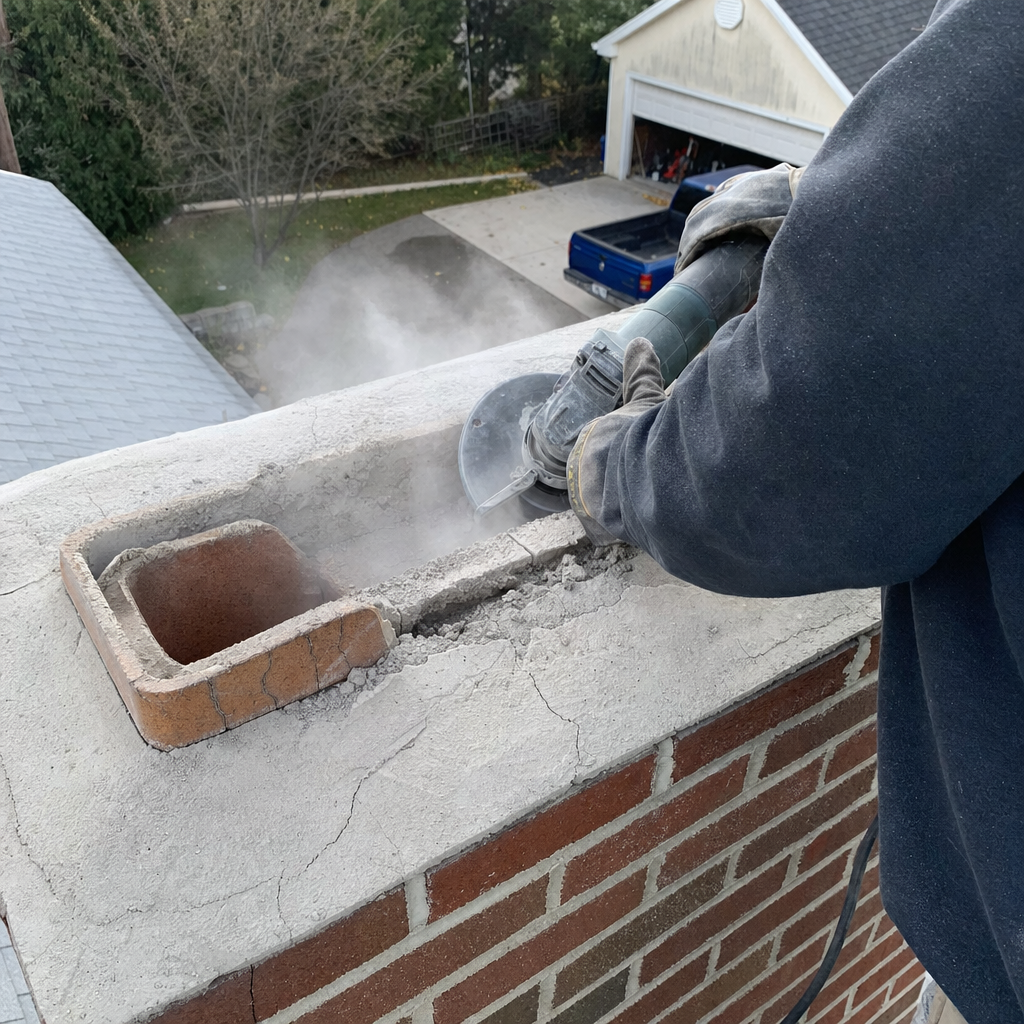
Here’s where Buffalo homeowners get tripped up. If you’re simply sealing an existing crown with a brush-applied product like those from Copperfield’s line — no permit. But if we’re removing and pouring a new cast-in-place crown, especially on a masonry chimney over 30 feet tall? The City of Buffalo’s building department may require a permit, particularly if scaffolding affects sidewalk or street access. We always verify before starting, and we document the determination in writing.
How Buffalo and Erie County Codes Work Together
New York State adopted the International Residential Code (IRC) as its baseline, then layered state-specific amendments. Buffalo adds its own municipal requirements on top. Understanding this three-tier system prevents surprises when the inspector arrives.
The NYS Residential Code governs chimney construction, clearances, and liner requirements statewide. It references NFPA 211 for detailed chimney standards and NFPA 54 for gas venting. For Buffalo homeowners, this means your chimney must meet minimum flue sizing, height above roof penetration, and clearance-to-combustibles rules regardless of your neighborhood.
The City of Buffalo Code enforces these standards through its Division of Permit & Inspection Services, located on the 9th floor of City Hall. For chimney work, Buffalo requires:
- Building permits for any liner replacement, rebuild, or new construction
- Fire inspection sign-off for solid-fuel appliance installations (wood stoves, pellet stoves, fireplaces)
- Certificate of Occupancy or compliance letter for new construction before use
Erie County’s role is primarily enforcement in unincorporated areas and towns without their own building departments — places like parts of Boston, NY or Collins. If you’re in Buffalo proper, you deal with the city. In Cheektowaga, West Seneca, or Hamburg, you may work with town building departments that follow Erie County’s adopted codes, which mirror NYS standards but with local amendment schedules.
Buffalo’s climate creates specific code-relevant conditions we address regularly. Our freeze-thaw cycles — often 80+ annual cycles with temperatures swinging from 15°F to 45°F in a single February day — accelerate masonry deterioration. When we rebuild a chimney in North Buffalo or replace a liner in a Riverside home, we’re not just meeting code minimums. We’re selecting materials and methods that handle Buffalo’s thermal stress. That might mean specifying a thicker stainless liner gauge from DuraFlex, or using HeatShield’s cerfractory foam with enhanced freeze-thaw resistance rather than a standard parging mix that would fail in three seasons.
NFPA 211 vs. New York State Enforcement
NFPA 211 — the National Fire Protection Association’s Standard for Chimneys, Fireplaces, Vents, and Solid Fuel-Burning Appliances — is the technical bible of chimney work. But it’s not law by itself. Here’s how it actually functions in New York.
NFPA 211 is a consensus standard, developed by industry experts and adopted by reference into building codes. When New York State incorporated the IRC, it specifically referenced NFPA 211 for chimney construction details and NFPA 54 for gas venting. This means NFPA 211’s clearance tables, inspection protocols, and liner requirements become legally enforceable through the state’s building code.
However, New York’s adoption includes gaps that matter practically:
- Inspection frequency: NFPA 211 recommends annual inspection and cleaning for solid-fuel systems. New York State does not mandate this by law for existing homes — but your insurance policy might, and failure to document compliance can void coverage after a chimney fire.
- Level 2 inspections: NFPA 211 requires a Level 2 inspection (camera scan, accessible areas examined) upon property sale or transfer of ownership. New York State does not statutorily require this, but Buffalo-area real estate transactions increasingly include it as a contract contingency. We’ve performed Level 2 inspections for home sales in Parkside, Elmwood Village, and the West Side where the buyer’s attorney specifically requested NFPA 211 compliance documentation.
- Liner sizing: NFPA 211 provides detailed tables for matching liner diameter to appliance BTU output and flue height. NYS code references these tables directly. In practice, Buffalo inspectors check this math on permitted jobs, and we’ve had installations flagged where a previous contractor oversized a liner for a high-efficiency gas insert, creating draft problems.
The critical distinction: NFPA 211 tells us how to build and maintain safely. New York State and Buffalo codes tell us when permits and inspections are required to verify that safety. A contractor who knows NFPA 211 but ignores local permit requirements is building to spec on paper while creating liability for you in reality.
In our experience, the contractors who say “we follow NFPA 211” as a reason to skip permits are misunderstanding the relationship. The standard and the code work together — one provides the technical method, the other provides the enforcement mechanism that protects you.
What a Code-Compliant Inspection Looks Like After a Liner Installation
When Titan Chimney Cleaning installs a new stainless steel liner — whether a DuraFlex flexible liner for a masonry restoration or a rigid Olympia Chimney system for a straight run — the job isn’t complete when the tools go back in the truck. The municipal inspection is the verification that protects your investment and safety.
Here’s what happens, step by step:
- Pre-installation permit: We pull the building permit before work begins, posting it at the job site. The permit application includes liner specifications, appliance BTU ratings, and intended use (wood, gas, or oil).
- Installation to manufacturer spec: Every connection, support, and termination follows the listed instructions for the specific liner brand. For a DuraFlex installation, this means proper top plate sealing, correct flexible-to-rigid transition if used, and maintaining required clearances to combustibles throughout the run.
- Post-installation contractor verification: Before calling for inspection, we run our own camera scan, verify draft with a manometer, and document clearances with photos. We provide this packet to the homeowner — it’s your record of proper installation.
- Municipal inspection scheduling: The City of Buffalo or relevant town building inspector visits, typically within 3-5 business days of request. They verify permit compliance, check visible connections, and may request to see our documentation.
- Fire inspection for solid fuel: For wood-burning systems, Buffalo Fire Prevention Bureau conducts a separate inspection focusing on hearth protection, clearance to combustibles, and proper capping/spark arrestor installation.
- Final sign-off and certificate: Upon passing, you receive a Certificate of Compliance or final inspection sticker. File this with your home records — it’s the document that proves code-compliant installation.
We’ve seen inspections fail for specific, avoidable reasons: a liner top plate installed without proper storm collar sealing (water intrusion risk in Buffalo’s lake-effect snow loads), insufficient clearance to framing in a chase (common in 1960s Kenmore splits with wooden chimney chases), or missing support brackets on a tall masonry run. These aren’t aesthetic issues — they’re safety failures that proper permitting catches before they become hazards or resale obstacles.
One South Buffalo homeowner called us after a “budget” liner installation left them with no documentation. The installer had vanished. We had to camera-scan, verify the installation against DuraFlex specs, and in one case, remove and reinstall a section that didn’t meet clearance requirements — all so they could get permitted and pass inspection. The original “savings” cost them an extra $1,800.
Permit Responsibility: Contractor vs. Homeowner
This is where Buffalo homeowners most commonly get burned, and why our guide on How to Hire a Chimney Cleaning Contractor in Buffalo: A Step-by-Step Guide stresses permit verification. New York State law does not automatically assign permit responsibility to either party. The building code applies to the property, and the property owner is ultimately liable for compliance.
In practice, reputable contractors handle permits as part of their service. At Titan Chimney Cleaning, we pull permits for all liner replacements, rebuilds, and new installations. It’s built into our workflow — Thomas shows up personally, assesses the job, and either has the permit in hand or files it that day. We don’t consider the job quoted until we’ve confirmed permit requirements.
But many chimney companies, especially transient operators and general handymen who’ve added chimney services, avoid permits entirely. Their excuses follow a pattern:
- “Chimney work doesn’t need permits in Erie County” — False. Buffalo requires them; many towns do too.
- “We’re just doing maintenance, not construction” — Sometimes true for cleaning, often false for liner work.
- “Permits just drive up your cost with city fees” — Buffalo’s residential permit fees for chimney work typically run $50-$150. The cost of unpermitted work discovered at sale is exponentially higher.
- “The homeowner can pull it if they want” — Technically possible, but signals a contractor avoiding accountability.
When a contractor says “we don’t need one for that,” ask specifically: “Will this work be inspected by the City of Buffalo building department?” If they hedge, deflect, or claim inspection isn’t necessary for “this type of job,” that’s a red flag. They’re not protecting you from bureaucracy — they’re protecting themselves from scrutiny.
The liability flows downhill to you, the homeowner. If your chimney liner fails and causes a fire, your insurance adjuster will request permit and inspection records. If you’re selling and the buyer’s inspector finds unpermitted work, you’re the one who must remedy it, permit it retroactively (often requiring exposed work), or reduce sale price. The contractor who skipped the permit is long gone, unfindable, or out of business.
In 11 years of owner-operated work, we’ve never understood the permit-avoidance strategy. The inspection protects us too — it’s third-party verification that our installation meets code, manufacturer spec, and professional standard. When Thomas Hernandez installs a Famco cap or completes a HeatShield smoke chamber repair, the permit and inspection documentation is as much our quality record as yours.
Why the Paper Trail Matters for Insurance and Resale
Buffalo’s housing market has tightened, and buyers are more scrutinizing than ever. A clean chimney inspection report from a recognized company carries weight. A missing permit for major chimney work carries more — in the wrong direction.
Insurance implications: After a chimney fire, your homeowner’s policy covers damage — unless investigation reveals unpermitted modifications or non-code installations. We’ve assisted homeowners in filing claims where our documented, inspected work was clearly distinguished from previous unpermitted modifications. The difference in claim processing was stark. One West Side homeowner’s claim was denied entirely because a previous owner had installed a wood stove without proper liner and inspection; the policy contained a standard exclusion for “work performed without required permits.”
Resale implications: Buffalo’s older housing stock — think Delaware District Victorians, North Park brick bungalows, Riverside colonials — means most buyers expect some chimney maintenance history. When we provide a clean Level 2 inspection report with documented maintenance history, it becomes a selling point. When a seller has no documentation for a recent liner replacement, it becomes a negotiation lever for the buyer.
Property records: Permitted work becomes part of your property’s official record with the City of Buffalo. This is public information that title companies and savvy buyers access. Unpermitted work does not exist in official records — until it’s discovered, at which point it exists as a problem.
We recommend homeowners create a chimney file: permits, inspection certificates, annual sweep records, and manufacturer warranties for liners or caps. For what to include, see our Chimney Cleaning & Sweep Maintenance Checklist for Buffalo Homeowners. When Titan Chimney Cleaning completes a job, we provide organized documentation specifically designed for this file. Nearly 300 homeowners have trusted us with this process, and the ones who keep records clean have smoother sales, faster insurance claims, and fewer surprises.
Common Mistakes to Avoid
- Assuming cleaning requires a permit. It doesn’t — but don’t let a contractor claim your “sweep and inspection” included hidden structural work that should have been permitted. We separate maintenance from modification clearly in every quote.
- Accepting verbal assurance that a permit “wasn’t needed.” Get it in writing, or verify directly with Buffalo’s Permit Office at (716) 851-4940. A two-minute call saves months of headache.
- Letting a contractor pull a permit in their name alone. The permit should reference your property address and be accessible to you. Some contractors use this as leverage — “cancel and I’ll pull the permit.” Protect yourself by understanding the permit is yours.
- Ignoring Buffalo’s specific solid-fuel inspection requirement. Gas liner replacements need building inspection. Wood-burning systems need both building and fire inspection. Skipping either leaves you incomplete.
- Not requesting manufacturer documentation for liner materials. When we install DuraFlex, HeatShield, or Olympia Chimney products, we provide spec sheets and warranty registration. Generic “stainless liner” with no brand identification often means contractor-grade material without listed clearances.
- Waiting until sale to discover permit gaps. If you had major chimney work in the last 10 years and have no permit record, address it now. Retroactive permitting is possible but more invasive and expensive.
When to Call a Professional
Call for expert assessment when you’re planning any chimney work beyond routine cleaning, when you’re buying a home with a fireplace (demand Level 2 inspection documentation), or when you discover previous work without permits or inspection records. In Buffalo’s climate, deferred chimney maintenance accelerates quickly — that small crown crack from January’s freeze-thaw becomes a full rebuild scenario by the following winter if water infiltration continues.
Titan Chimney Cleaning Greater Buffalo offers free estimates throughout Buffalo and Erie County — call (833) 632-3568. Thomas Hernandez serves as lead technician on every job, from routine sweeps to full liner replacements with proper permitting and inspection coordination. One company, full chimney: cleaning, repair, fireplace services, cap and crown installation, and liner rebuilds using professional-grade materials from DuraFlex, HeatShield, Gelco, and other recognized brands.
Frequently Asked Questions
No. Routine chimney sweeping, creosote removal, and standard Level 1 or Level 2 inspections do not require a building permit in Buffalo or anywhere in New York State. If a contractor claims your “cleaning” requires a permit fee, request specifics — they may be bundling unnecessary charges or mischaracterizing the work scope. Call Titan Chimney Cleaning at (833) 632-3568 for a transparent quote on maintenance services.
Residential chimney permits in Buffalo typically range from $50 to $150 depending on project scope, with liner replacements generally at the lower end and full rebuilds at the higher end. Erie County towns may vary slightly. The permit fee is minor compared to the cost of unpermitted work discovered during a home sale or insurance claim. For exact current fees, contact Buffalo’s Division of Permit & Inspection Services directly.
You can, but you may face buyer demands for retroactive permitting, price reductions, or repair credits. In Buffalo’s competitive market, unpermitted work increasingly triggers renegotiation. The cleanest path is obtaining a retroactive permit and inspection, which may require exposing some work for inspector verification. We recommend addressing this proactively rather than at closing — call (833) 632-3568 for assessment.
NFPA 211 is a technical standard for chimney construction and maintenance; Buffalo’s building code adopts it by reference and adds permit/inspection enforcement. NFPA 211 tells professionals how to build safely; Buffalo’s code tells homeowners when that safety must be verified by municipal inspection. A contractor following NFPA 211 but skipping permits is meeting the technical standard while violating the legal requirement.
Legally, the property owner is responsible for code compliance, but reputable contractors include permit procurement in their service. At Titan Chimney Cleaning, we handle all permit filing and inspection scheduling for liner replacements, rebuilds, and new installations. If a contractor asks you to pull the permit, ask why — it may indicate they’re unlicensed, avoiding accountability, or unfamiliar with Buffalo’s process.
Contact the City of Buffalo Permit Office with your property address and approximate work date. Permitted work from 2000 onward is generally in their database. For Erie County towns, contact the relevant building department. If no record exists and the work involved liners, rebuilds, or structural changes, assume it was unpermitted and consider assessment. We provide documentation review as part of our Chimney Cleaning & Sweep in Buffalo service — call (833) 632-3568 to schedule.
The Bottom Line
Buffalo homeowners face a three-tier system — NFPA 211 for technical standards, NYS Residential Code for statewide requirements, and Buffalo’s municipal enforcement for local verification. The gap between “technically correct” and “legally compliant” is where liability lives. Routine cleaning needs no permit, but liner replacements, rebuilds, and structural modifications do, with inspection to verify. The contractor who skips this step saves themselves time while transferring risk to you. Document everything, verify permit status independently, and work with professionals who treat the paper trail as seriously as the physical work. In 11 years of exclusive chimney focus across Buffalo, we’ve learned that the homeowners who sleep easiest are the ones with files full of permits, inspection certificates, and maintenance records — not the ones hoping nobody asks. For more guides & resources on protecting your home, explore our blog.
Written by Thomas Hernandez, Owner & Lead Technician at Titan Chimney Cleaning Greater Buffalo, serving Buffalo since 2015.