
Chimney Cap Installation Cost in Buffalo, NY: What You’ll Actually Pay
Chimney cap installation in Buffalo typically runs $285–$650 for a standard single-flue cap, $450–$895 for a full-width multi-flue cover, and $675–$1,200 for a wind-directional cap engineered for southtowns snowbelt exposure. Most Buffalo-area homeowners land in the $350–$550 range for a properly fitted, professional-grade cap installed on a first-story chimney. Call (833) 632-3568 for a free, exact quote — Thomas Hernandez measures every flue personally before ordering.
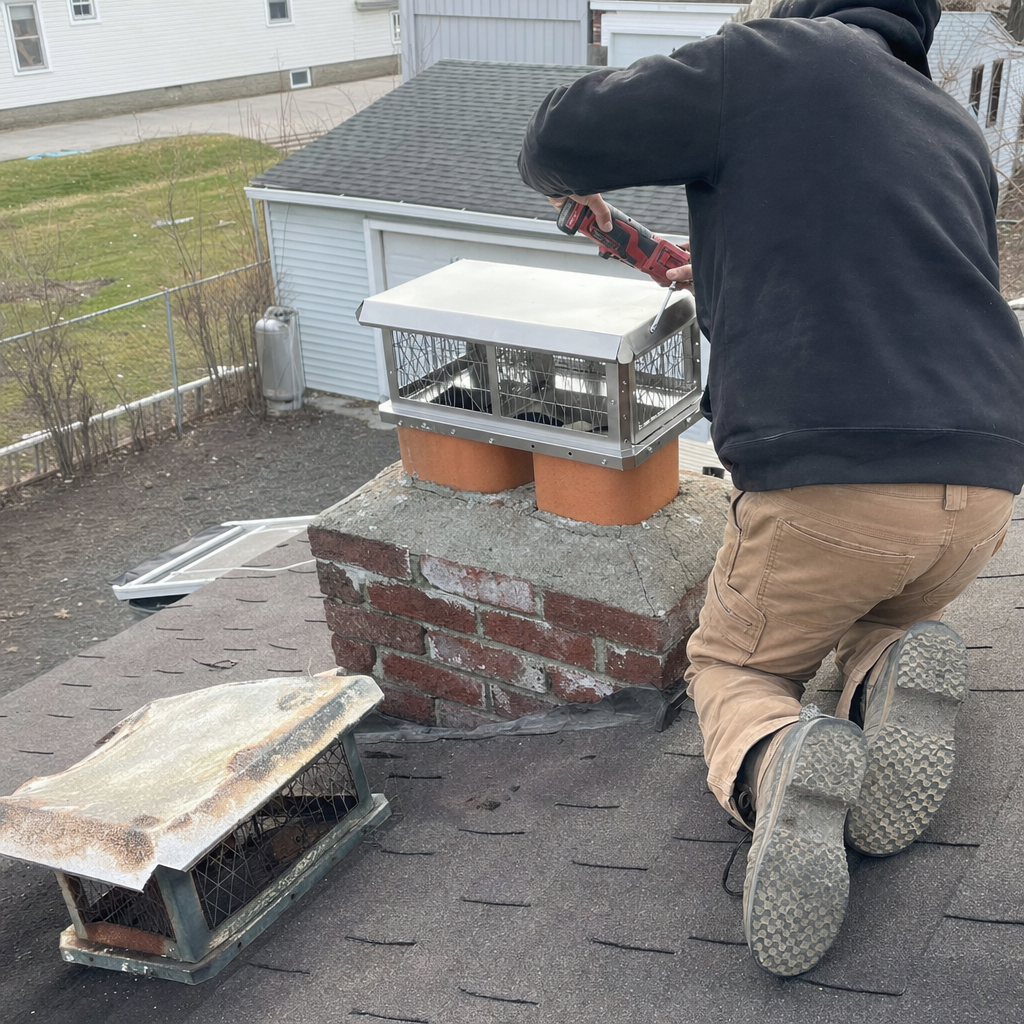
After a major lake-effect dump in Orchard Park or Hamburg, we’ve opened flues and found them packed tight with wind-driven snow and ice. A cheap universal cap lets that happen. Here’s what the right cap costs, and why the difference in spec matters more in the southtowns than almost anywhere else in the country.
Why Buffalo’s Climate Changes What “Chimney Cap” Means
Most of the country treats a chimney cap as a rain guard and critter blocker. In Buffalo, it’s snow-defense equipment.
Lake Erie lake-effect events routinely drop 2–3 feet of wet, heavy snow on us in 24–48 hours, and the southtowns — Orchard Park, Hamburg, West Seneca — can exceed 150 inches annually. That snow doesn’t fall straight down. It comes horizontally at 40–50 mph, driven by winds off the lake, and it finds every gap, mesh opening, and poorly fitted edge. We’ve pulled caps off after one season where the mesh was deformed from ice expansion and the fasteners were rusted through from freeze-thaw cycling.
The south and east faces of chimneys catch the worst of it. Those are the lee sides in our typical wind patterns, and they’re where we find flues packed solid, blocking combustion gases and creating carbon monoxide backdraft conditions inside the home. It’s a failure mode virtually unknown in most of the country, but we recognize it by December every year.
Buffalo’s housing stock compounds the challenge. Our peak growth era ran roughly 1880–1930, leaving dense neighborhoods of brick Victorians, Queen Annes, and early-20th-century frame homes across the East Side, Elmwood Village, and South Buffalo — most with original multi-flue masonry chimneys built for coal furnaces, later converted to oil or gas. Those chimneys often have oversized flue liners, irregular crown conditions, and mortar joints already stressed by 80–100 freeze-thaw cycles per season. A cap that doesn’t account for that substrate is a cap that fails.
Buffalo’s position directly downwind of Lake Erie subjects these overwhelmingly pre-WWII masonry chimneys to among the most punishing freeze-thaw cycling of any major U.S. city, with wet lake-effect snow repeatedly saturating mortar joints that then refreeze — accelerating spalling and crown deterioration far faster than in neighboring Rochester or Erie. For Buffalo homeowners, annual chimney cleaning is inseparable from structural masonry inspection, because a chimney that passed visual scrutiny in October can have open mortar joints and cracked crowns by April.
Cap Types for Buffalo: Not All Specs Handle Lake-Effect Snow
We install three categories of cap, and the price spread between them reflects real performance differences in our climate — not just brand names or metal thickness.
Standard Single-Flue Caps
These cover one flue individually, typically with a galvanized or stainless steel lid and mesh sides. In Buffalo, we specify 304 stainless minimum, 24-gauge or heavier, with welded seams — not the crimped, snap-together units that box stores move by the pallet. The mesh needs to be 5/8-inch or 3/4-inch woven stainless, not the cheaper expanded metal that ices over solid.
Even a “standard” cap from Titan is spec’d differently than what you’ll find at a hardware store. We source through Olympia Chimney and Gelco — both manufacture to actual chimney-industry specs with proper fastening hardware, not the self-tapping screws and strap clamps that vibrate loose on a Buffalo roof by March. A single-flue cap in 304 stainless, properly fitted and secured, runs $285–$450 installed for a first-story chimney in typical condition.
Full-Width Multi-Flue Covers
When a chimney has two or more flues — common on those converted coal-era systems — individual caps leave the crown exposed between them. That crown takes direct snow load, melt infiltration, and freeze-thaw damage. An Affordable Chimney Cap & Crown in Buffalo, NY as a full-width cover shields the entire crown, extending the chimney’s service life significantly.
These are heavier builds: 24-gauge stainless or copper, with proper counter-flashing integration and structural bracing across the span. Installation takes longer because we’re not just dropping a cap on a flue — we’re integrating with the crown surface, often after minor crown repair or sealing, which affects your Chimney Crown Repair Cost in Buffalo, NY. $450–$895 installed, with the upper end covering larger spans, copper material, or crown prep work.
Wind-Directional Caps
Here’s where Buffalo diverges from national pricing conversations. A wind-directional cap — sometimes called a rotating or weather-vane cap — uses a turbine-style hood that orients itself downwind, creating positive draft while blocking direct wind and snow entry. In the southtowns snowbelt, on exposed properties in Hamburg or Orchard Park, this isn’t an upgrade; it’s sometimes the only spec that keeps the flue clear in a January nor’easter.
We don’t recommend these for every Buffalo home. A sheltered city property in North Buffalo or a ranch with windbreaks in West Seneca may never need the complexity. But when Thomas measures a chimney on an open hill in Boston or Eden and sees the exposure angle, he’ll tell you straight whether a standard cap is throwing money away. $675–$1,200 installed, with the range reflecting cap size, material (stainless versus copper), and access difficulty.
What Drives the Final Number Up or Down
We’ve given ranges, but here’s the honest breakdown of what moves you within them. No surprises when we quote — these are the same factors Thomas weighs on every job.
| Cost Factor | Low End | High End | What Changes |
|---|---|---|---|
| Cap material (304 stainless) | $85 | $180 | Single-flue standard vs. multi-flue span |
| Cap material (copper) | $220 | $450 | Custom fabrication, patina finish |
| Flue measurement & fitting | Included | $75 | Ir liner, odd sizing, custom adapter |
| Installation height (1st story) | Base rate | Base rate | Standard ladder access |
| Installation height (2nd story+) | +$125 | +$275 | Second-story Victorian in Elmwood Village vs. ranch in West Seneca |
| Crown condition / pre-install repair | $0 | $340 | Minor seal vs. partial crown rebuild |
| Fastening / masonry anchoring | Included | $95 | Standard flue clamp vs. corbelled brick anchor system |
| Typal installed total | $285 | $1,200 | Single-flue stainless, 1st story to wind-directional copper, 2nd story + crown work |
The height factor catches people off guard who’ve only priced online. A second-story Victorian chimney in Elmwood Village with a steep-pitch roof and ornamental brickwork is a fundamentally different job than a single-story ranch in West Seneca with walkable shingles. We don’t pad the quote — we bring the right ladder, the right anchor system, and the time to do it without rushing. Rushing on a Buffalo roof in January is how caps end up crooked, leaking, or in your yard after the next wind event.
Crown condition is the other hidden variable. We won’t install a cap over a cracked, spalling crown and call it done. If Thomas finds open mortar beds or frost damage during measurement, he’ll show you — phone photos, plain explanation — and quote the repair honestly. Sometimes it’s a $45 seal with HeatShield CrownCoat. Sometimes it’s more. But a cap on a failed crown is a cap that fails with it, and we’re not in business for one-season fixes.
How Titan’s Process Prevents the Failures We See on Other Roofs
Here’s where owner-operator structure matters for your actual result.
Thomas Hernandez measures every flue himself before ordering. Not a crew member with a tape measure and a guess. Not a subcontractor who’s never seen your roof before install day. He climbs, he measures diameter and shape (round, square, rectangular, oval — they all take different adapters), he assesses crown slope and condition, and he selects the cap from our Olympia Chimney and Gelco catalogs based on that specific data.
Improperly fitted caps fail in Buffalo’s first season. Too small, and wind drives snow around the edges. Too large, and the clamp system doesn’t seat properly, working loose through freeze-thaw. Wrong mesh size, and ice bridges across the screen, blocking draft entirely. We’ve removed caps installed by other companies where the “technician” clearly never measured — just grabbed a standard size from the truck and hoped.
Our 11 years in this trade, exclusively chimneys, means we’ve seen how each spec performs through Buffalo winters. The brands we use — Olympia Chimney and Gelco — manufacture to professional-grade standards: proper gauge thickness, welded (not crimped) seams, stainless fasteners included, wind-load ratings documented. Big-box contractor-grade units save $40 on material and cost you $300 in replacement labor when they fail.
If I wouldn’t let my own family light that fireplace, I’m going to tell you straight.
When Does a Chimney Cap Installation Become a Larger Repair?
Sometimes the cap quote isn’t just a cap quote, and we’d rather tell you now than surprise you later.
We find three common conditions in Buffalo that extend the scope:
- Crown rebuild needed: If the concrete crown is cracked through, spalling, or sloped inward (holding water instead of shedding it), we rebuild with proper concrete mix and slope before capping. Crown rebuilds run $450–$1,100 depending on size and accessibility.
- Flue liner damage: Those oversized coal-era flues often have cracked clay liners or missing sections. A cap won’t fix draft problems from a failed liner. We handle full liner replacement with DuraFlex stainless relining pipe — Chimney Cap & Crown work often reveals liner issues we can address in the same visit.
- Structural masonry decay: Open mortar joints, loose brick, or leaning chimney stacks need repointing or rebuild before any cap investment makes sense. We do this work too — one company, full chimney — so you’re not coordinating multiple contractors in a Buffalo winter.
Thomas will walk you through what he finds, show you photos, and give you prioritized options. Not every problem needs immediate fixing. Some do. You’ll get a straight assessment either way.
FAQs
Most Buffalo homeowners pay $350–$550 for the best chimney cap & crown in Buffalo, NY, professionally installed on a first-story chimney. Second-story installations, multi-flue covers, or wind-directional caps for southtowns snowbelt exposure run higher — typically $675–$1,200. Call (833) 632-3568 for an exact quote; estimates are free and Thomas measures every flue personally.
Repair is rarely worth it for failed caps. By the time a cap is rusted, mesh-deformed, or fasteners are stripped, the metal itself is compromised — and patching it costs nearly as much as proper replacement with a unit that will last. We occasionally resecure a cap that came loose due to improper original installation, but if the cap is more than 5–7 years old in Buffalo’s climate, replacement with current-spec stainless is the better value. Call (833) 632-3568 and we’ll assess whether yours is salvageable.
Yes, and in Buffalo we often do. A missing or failed cap in January is an emergency — snow and ice entering an open flue creates blockages and moisture damage that worsen by the day. We work through winter with proper safety protocols for roof work in cold conditions, though extreme wind or active lake-effect may delay scheduling by a day or two. If your flue is open right now, don’t wait for spring; call (833) 632-3568 and we’ll prioritize it.
Visible rust stains on the chimney brick, mesh screens clogged with creosote or ice, water in the firebox, or draft problems that started recently are all warning signs. After wind events, check if the cap is still seated squarely — we’ve found caps rotated or partially detached after Buffalo’s typical winter storms. If you’re unsure, schedule an inspection; Thomas will show you exactly what’s happening on your roof and whether the cap is the problem or a symptom of deeper issues. Call (833) 632-3568 to book.
What to Expect When You Call Titan
You’ll talk to Thomas Hernandez directly — owner and lead technician, not a dispatcher reading a script. He’ll ask about your chimney (flue count, approximate age, any known issues), your location in Greater Buffalo, and what you’ve observed. If you can send a photo from the ground or describe the roof access, he’ll give you a realistic range before scheduling.
On inspection day, he climbs, measures, photographs what he finds, and explains your options in plain English. No pressure, no surprise upsells. Nearly 300 homeowners have trusted us across 11 years in this single trade, and our 4.7-star average from 297 verified reviews reflects the repeat calls we get from people who know we’ll show up personally and stand behind the work.
We install professional-grade chimney caps from Olympia Chimney and Gelco — not contractor-grade substitutes — and we back the installation with our workmanship commitment. One company, full chimney: from this cap to your annual sweep to a full liner rebuild if you ever need it.
Call (833) 632-3568 today for your free estimate. Thomas Hernandez serves as lead technician on every job, and we’ll get your flue protected before the next lake-effect event rolls through.
Written by Thomas Hernandez, Owner & Lead Technician at Titan Chimney Cleaning Greater Buffalo, serving Buffalo, NY.