
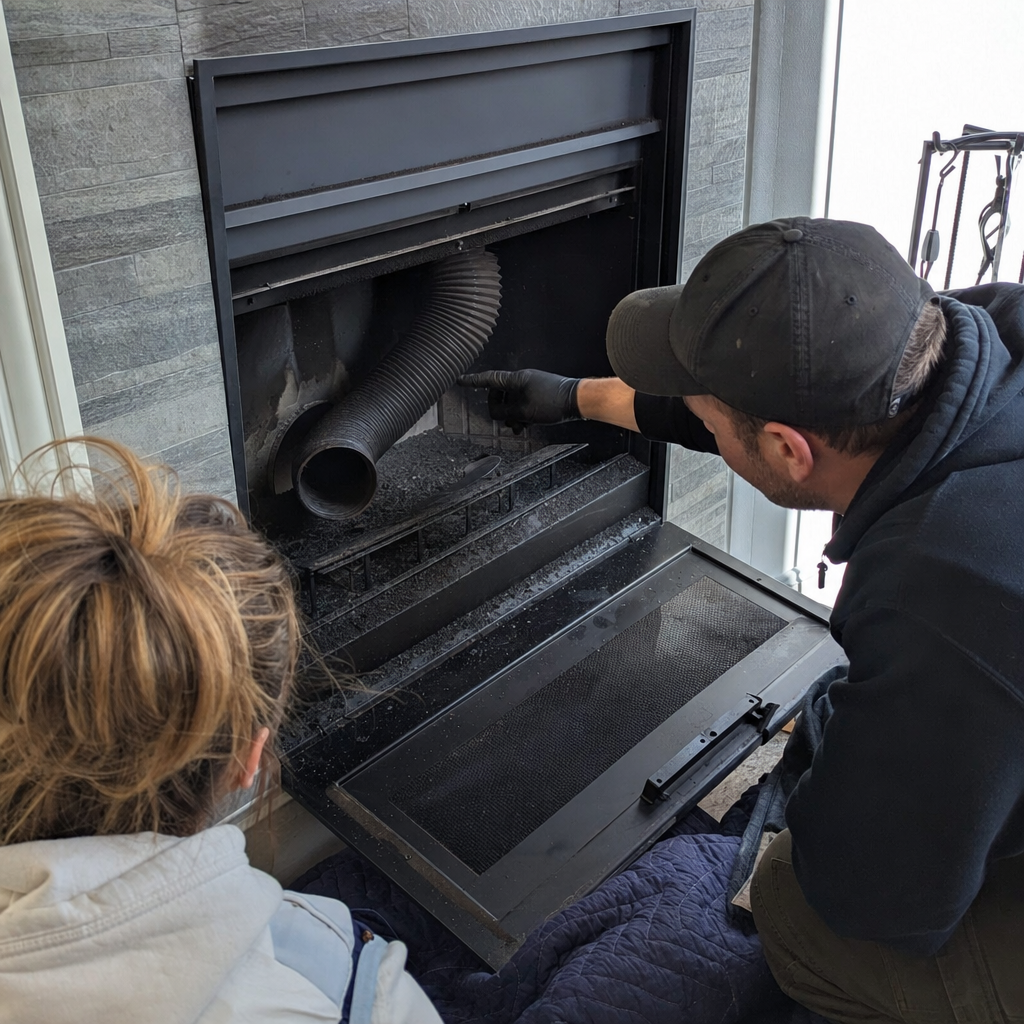
Creosote Buildup Is Condensed Smoke Tar That Coats Your Flue — and in Buffalo’s Pre-War Chimneys, It Forms Faster and Harder Than Almost Anywhere Else
Creosote buildup is the tar-like residue left behind when wood or fossil fuel smoke cools and condenses on chimney walls. In Buffalo, where thousands of homes still run gas inserts through coal-era flues built in 1890–1930, that condensation happens sooner and heavier because the oversized liner lets gases linger and cool before they ever reach the cap. If you’re noticing a sharp, chemical odor when you fire up the hearth, or you’re finding black, flaky debris in the firebox, you’re almost certainly looking at stage 1 or stage 2 creosote — and in older East Side and Elmwood Village homes, we regularly pull out stage 3 glaze that standard wire brushes won’t touch. Call (833) 632-3568 and Thomas will walk you through what you’re actually dealing with.
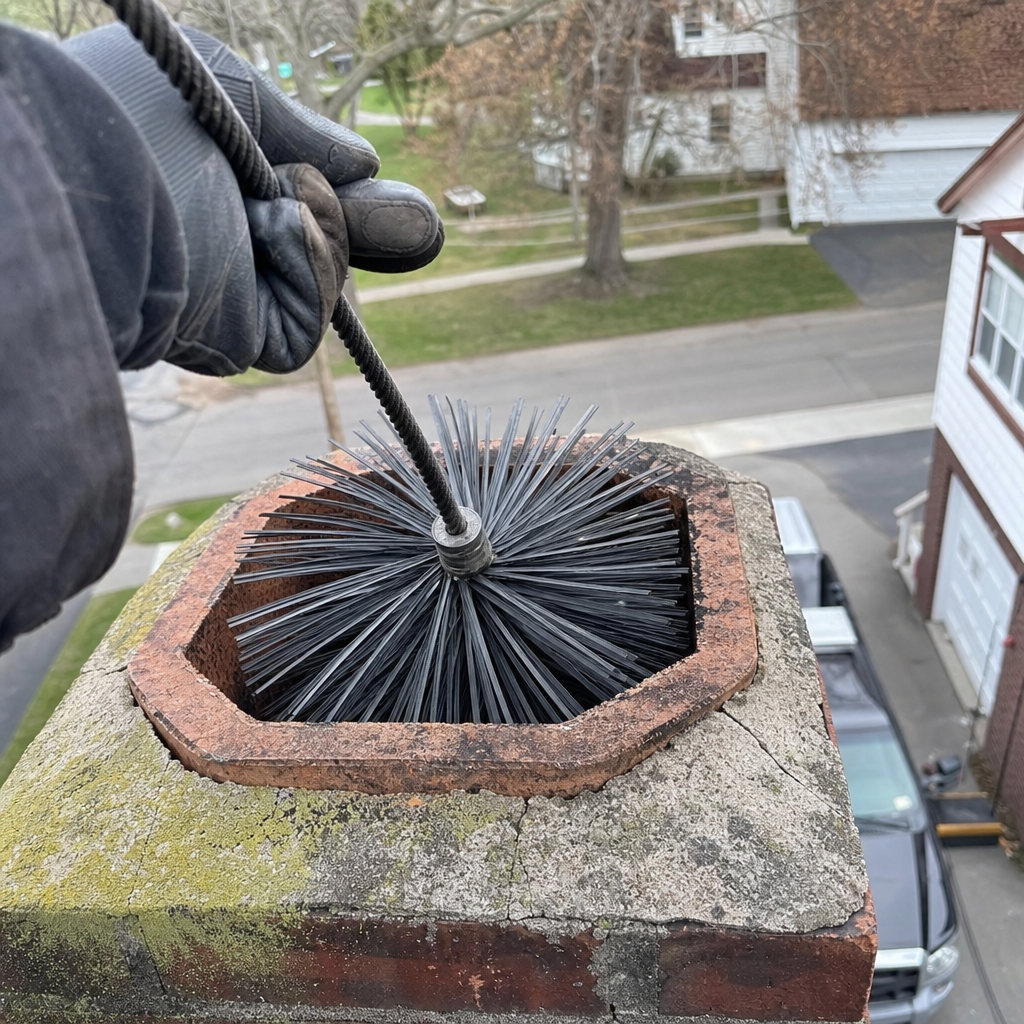
What Creosote Actually Is, Stage by Stage
The NFPA breaks creosote into three stages, and each one behaves differently in your flue — and in a chimney fire. Most Buffalo homeowners we meet assume it’s all just “soot,” but the distinction matters for how we clean it and whether it’ll come back.
Stage 1 — Soot: This is loose, powdery, black or brown carbon. It brushes off easily with the Best Chimney Cleaning & Sweep in Buffalo, NY, and it’s what you’d expect from a well-seasoned hardwood fire in a properly sized liner. We see this in newer Hamburg or Orchard Park builds with correctly matched flues. It’s a maintenance item, not an emergency.
Stage 2 — Crunchy flakes: The smoke has started to condense into harder, layered deposits that look like black corn flakes stuck to the tile. Brush pressure alone won’t clear it — we need rotary whips or chains to break it free. This is where most of Buffalo’s pre-war housing stock lives, especially where a gas insert was shoehorned into a coal flue without resizing.
Stage 3 — Glaze creosote: This is the dangerous one. A shiny, tarry, rock-hard coating that looks like burnt caramel poured down your flue. It’s extremely insulative — meaning it traps heat against the liner during a chimney fire rather than letting it dissipate — and it’s chemically bonded to the surface. Standard brushing polishes it. Stage 3 glaze requires chemical treatment to soften it, then rotary mechanical removal. We’ve pulled inch-thick glaze out of chimneys in South Buffalo where the homeowner had no idea, because the fireplace “still worked fine.”
In a chimney fire, stage 1 burns off fast. Stage 2 cracks and spalls, potentially damaging liner tiles. Stage 3 glaze superheats, can reach temperatures exceeding 2,000°F, and because it’s so insulative, it forces that heat directly into the surrounding masonry — the exact masonry that’s already been compromised by Buffalo’s freeze-thaw cycling. That’s when you get exterior chimney wall discoloration, cracked crowns, or worse.
Why Buffalo Homes Build Creosote Faster Than the National Average
Here’s the thing nobody tells you: creosote isn’t just about burning “bad” wood or having too many fires. It’s about physics — specifically, how long your combustion gases stay hot enough to exit before they cool and condense.
Buffalo’s housing stock is uniquely vulnerable. The city’s peak building era, roughly 1880 to 1930, left us with dense blocks of brick Victorians and Queen Annes in neighborhoods like Elmwood Village, the East Side, and North Buffalo. Those homes were built with multi-flue masonry chimneys sized for coal furnaces — massive flue dimensions, often 12×12 inches or larger, designed to handle the draft requirements of solid-fuel basement burners.
Then came the conversions. Coal to oil. Oil to gas. Gas inserts and direct-vent appliances installed into flues that are now three times too large for the appliance they’re venting. An oversized flue means slow, lazy draft. Gases that should rocket upward at 300–400°F instead meander, cooling below 250°F where condensation begins. The water vapor and unburned hydrocarbons in that smoke hit the cooler flue walls and stick. Layer by layer, season by season.
We’ve swept chimneys in Allentown where the homeowner burned less than a cord per winter and still packed in stage 2 creosote — because the flue was so oversized that even modest use created condensation conditions. Meanwhile, a properly lined flue in West Seneca with twice the wood consumption might show only light stage 1 soot. The difference isn’t the homeowner; it’s the system.
The lake-effect cold makes it worse. When Buffalo drops into single digits after a heavy snow — common from December through March — the thermal mass of those brick chimneys is already pre-chilled. The first fire of the evening sends warm gases up into a flue that’s essentially a heat sink. Condensation starts within the first few feet. During the polar vortex events that seem to hit us harder than Rochester or Erie, we see accelerated glazing in chimneys that were “fine” the prior fall.
Common Local Scenarios We See Every Season
After 11 years and nearly 300 jobs across Greater Buffalo, certain patterns repeat. These aren’t hypotheticals — they’re the actual conditions Thomas Hernandez encounters, and they shape how we talk to homeowners about what’s really going on.
The “It Was Just Cleaned” Return Customer: A homeowner in North Buffalo calls us after another company swept their chimney in September. By February, they’re smelling that sharp creosote odor again. We run the camera and find stage 2 buildup already reformed. The previous sweep was competent — the brush removed what was there. But nobody addressed the 10×10 flue venting a 30,000 BTU gas insert. The creosote wasn’t the problem; it was the symptom. We clean it again, then discuss whether a Chimney Cleaning & Sweep with liner evaluation makes sense, or if it’s time to talk about a DuraFlex or HeatShield liner downsize.
The Heavy Winter Burner: South of the city, in the snowbelt towns like Hamburg and Orchard Park, some homeowners burn wood as primary or significant supplementary heat. After a big lake-effect dump — the kind that drops 30 inches in 36 hours — they’ll stoke fires hotter and longer than usual, sometimes running the insert overnight at maximum output. Here’s the risk: that glaze creosote they didn’t know about, built up over years in an oversized flue, is now receiving sustained thermal stress. When glaze hits sudden temperature spikes, it can crack the liner beneath it or, worst case, ignite. We inspect these systems every spring and find thermal shock damage — hairline cracks in flue tiles, spalled mortar joints — that wasn’t visible the previous October.
The Gas Insert Surprise: Elmwood Village and the West Side are full of beautifully restored fireplaces with gas log sets or inserts installed by prior owners. The new owners assume “gas is clean” and skip annual inspection. But propane and natural gas both produce water vapor and trace hydrocarbons, and in an oversized flue, that moisture condenses and mixes with any residual soot to form acidic, tarry deposits. We’ve pulled wet, corrosive sludge out of “gas-only” chimneys that were destroying the liner from the inside. The homeowner smelled something “off” — that was the creosote-and-acid cocktail eating their flue tile.
The Post-Storm Blockage: After major lake-effect events, we regularly find chimney caps and flue openings packed with wind-driven snow and ice, particularly on south and east exposures in the southtowns. A blocked cap means combustion gases can’t exit. They back up, cool rapidly in the flue, and deposit creosote at accelerated rates — sometimes in a single weekend of burning. It’s a failure mode most chimney professionals outside the Great Lakes snowbelt never encounter, but it’s a recognizable seasonal pattern here. We install Famco and Olympia Chimney caps specifically rated for our snowload and wind conditions, because a standard big-box cap becomes a plug in a Buffalo February.
Why Cleaning Alone Doesn’t Fix the Buffalo Creosote Cycle
We’re upfront about this because it’s the conversation Thomas has at kitchen tables across the city: we can remove whatever creosote is in your flue. We’ve got the rotary gear, the chemical treatments, and the camera systems to do it thoroughly. But if your flue is three times the diameter your appliance needs, that creosote is coming back at the same rate — or faster, as the glaze residue left in pores provides a bonding surface for new deposits.
The real fix is matching the flue to the appliance. That might mean:
- A stainless steel liner insert — DuraFlex or Olympia Chimney round liners sized precisely to your insert’s output, creating the fast, hot draft that carries gases out before they condense.
- HeatShield cerfractory resurfacing — for flues with intact structure but eroded or missing mortar joints, this restores a smooth, correctly sized vent path without full liner replacement.
- Flue tile replacement or full rebuild — when freeze-thaw damage from Buffalo’s 80–100 annual cycles has cracked the structure beyond resurfacing.
This is why Titan’s full-scope capability matters, and why Thomas Hernandez handles every job personally. An Affordable Chimney Cleaning & Sweep in Buffalo, NY might clean your flue and leave. They don’t size liners. They don’t install Gelco or Copperfield caps and crowns. They don’t rebuild. So when the creosote returns in 18 months, you’re calling someone else — or worse, you’re not calling anyone until there’s an odor or a smoke event.
We’ve built our reputation on telling homeowners the full story, even when it means recommending work that doesn’t put money in our pocket this month. If a liner downsize isn’t in your budget this year, we’ll show you the camera footage, explain the timeline, and set an inspection schedule that catches buildup before it reaches stage 3. If I wouldn’t let my own family light that fireplace, I’m going to tell you straight.
What a Professional Creosote Inspection Actually Involves
When Thomas arrives at a Buffalo home, the process is methodical — and it’s the same whether we’re responding to a known problem or doing routine annual maintenance.
We start with exterior visual: crown condition, cap integrity, mortar joint inspection, any spalling or discoloration that suggests past overheating. Then interior firebox and smoke chamber, looking for creosote fallout, staining patterns, or damaged brick. The critical piece is the NFPA Level 1 or 2 inspection with a chimney camera — we run a high-resolution camera up the full flue length, recording every tile joint, every glaze deposit, every crack or gap.
For stage 2 and 3 buildup, we document thickness and location. Stage 3 glaze gets flagged for chemical pretreatment — we apply a modifier that breaks the tar bond over 24–48 hours, then return with rotary chains or whips to remove it mechanically. This isn’t a same-day process for heavy glaze, and any sweep who tells you otherwise is either polishing it smooth or missing it entirely.
After cleaning, we run the camera again. You see the before and after. If we find liner damage, misalignment, or the oversized-flue condition that’s driving your buildup, we explain it with the footage on screen — no guessing, no scare tactics.
When Creosote Becomes an Immediate Safety Concern
Most creosote buildup develops gradually enough that annual inspection catches it. But certain conditions in Buffalo homes push the timeline faster, and certain symptoms mean don’t-wait.
Call for immediate inspection if you’re experiencing:
- A sharp, acrid, or chemical odor from the fireplace when not in use — this is volatile compounds off-gassing from active creosote deposits, often stage 2 or 3
- Visible shiny black or brown tar-like material on damper blades or firebox walls
- Smoke spillage into the room at fire startup, suggesting blocked or restricted flue
- Discoloration or heat damage to surrounding wall or mantel materials
- A “popping” or “clicking” sound from the chimney during burning — expansion of glaze deposits under thermal stress
During extreme cold snaps following lake-effect events — the kind where Buffalo hits negative wind chills and your chimney’s thermal mass is already frozen — the temperature differential between your fire and the flue wall is at maximum. This is when glaze-coated liners experience the most thermal shock. If you know you have heavy buildup and you’re about to run sustained high-output fires in subzero conditions, that’s a risk window. Get it inspected first.
Preventing Creosote Buildup in Buffalo’s Unique Conditions
The fundamentals apply everywhere, but Buffalo’s climate and housing stock require specific adjustments.
Burn dry, seasoned hardwood. Wet or green wood smolders, producing more unburned hydrocarbons that condense as creosote. In our humid lake-effect summers, even stored wood can reabsorb moisture. We recommend two full seasons of covered drying for oak or maple, and moisture meter testing before burning.
Build hot, fast-starting fires. Extended smoldering — “keeping the coals alive” overnight — is creosote-intensive. Start with kindling and small splits, establish strong draft quickly, then add larger fuel. A hot flue is a clean flue.
Don’t skip the annual inspection because you “hardly use it.” In Buffalo’s pre-war housing, the flue condition and the appliance mismatch matter more than burn frequency. We’ve found stage 2 buildup in gas-insert chimneys that hadn’t burned wood in a decade.
Address the flue sizing. This is the Buffalo-specific point we return to. If your chimney was built for coal and now vents a modern appliance, no amount of “proper burning technique” fully compensates. The physics are wrong. A liner evaluation isn’t upselling — it’s engineering.
Install snow-rated caps and maintain crown integrity. Given our snowload and freeze-thaw cycles, a standard cap becomes a blockage point. We specify Famco and Olympia Chimney components rated for our conditions, and we inspect crowns for cracks that let meltwater saturate mortar joints — because a structurally compromised flue accelerates every other problem.
FAQs
A standard Chimney Cleaning Cost in Buffalo, NY for stage 1 soot buildup typically runs $150–$250, while stage 2 removal with rotary equipment ranges $250–$400, and stage 3 glaze creosote requiring chemical pretreatment and multiple passes can reach $400–$700 depending on flue height and accessibility. These are general ranges for Greater Buffalo — your actual quote depends on what the camera inspection reveals. Call (833) 632-3568 for a free, no-pressure estimate; Thomas will assess your specific flue and explain exactly what stage you’re dealing with before any work begins.
Stage 1 soot can sometimes be reduced with proper fireplace tools and a chimney brush, but stage 2 and stage 3 creosote — the kinds we most commonly find in Buffalo’s pre-war chimneys — require professional rotary equipment and, for glaze, chemical modifiers that aren’t available to homeowners. More importantly, without a camera inspection, you can’t see what you’re missing: cracked flue tiles, mortar gaps, or the oversized-flue condition that’s causing the buildup in the first place. For safety, we recommend professional evaluation of any creosote beyond light surface soot. Call (833) 632-3568 and we’ll show you exactly what’s in your flue.
That sharp, tarry odor is volatile organic compounds off-gassing from active creosote deposits — usually stage 2 or 3 — when summer humidity and temperature swings activate them. In Buffalo, where lake-effect humidity can spike even in July, and where many homes have unlined or oversized flues that never fully dry out, this is a common complaint. The smell is actually a useful warning: it means you have significant buildup that needs removal, and possibly liner correction to prevent recurrence. A sweep eliminates the odor source; a liner evaluation addresses why it formed. Call (833) 632-3568 to schedule before fall burning season.
The NFPA recommends annual inspection for all wood-burning systems, and in Buffalo’s climate and housing stock, we consider that a minimum — not a maximum. Homes with pre-war chimneys, gas inserts in oversized flues, or heavy winter burning may benefit from inspection every 6–9 months, particularly after severe lake-effect winters that stress masonry and cap integrity. After our 11 years across the city, we’ve found that homeowners who inspect annually catch buildup at stage 1; those who wait two or three years almost always reach stage 2 or 3, with correspondingly higher removal cost and greater safety risk. Call (833) 632-3568 to set a schedule that matches your specific system and burn pattern.
If you’d rather have it looked at, Titan Chimney Cleaning Greater Buffalo offers a no-pressure assessment in Buffalo — call (833) 632-3568.
Written by Thomas Hernandez, Owner & Lead Technician at Titan Chimney Cleaning Greater Buffalo, serving Buffalo, NY.