
Last updated July 15, 2026
Chimney Cleaning & Sweep Maintenance Checklist for Buffalo Homeowners
After 11 years in Buffalo chimneys, the calls Thomas dreads most aren’t the urgent ones — they’re from homeowners who noticed something six months ago and talked themselves out of it. The faint tar smell in August. The white powder blooming on the attic-side of the chimney breast. The way smoke lingered in the living room last February but cleared by March, so they stopped thinking about it. In a city where lake-effect moisture drives freeze-thaw cycles hard from November through April, small chimney defects don’t stay small. This guide gives you a room-by-room, ladder-free inspection routine you can actually perform — plus the seasonal trigger points that tell you when to call before a $200 sweep becomes a $4,000 liner replacement.
Quick Answer
Buffalo homeowners should inspect their chimney system twice yearly — in April after heating season and in August before it resumes — checking for creosote buildup, moisture damage, and venting problems from the ground floor, attic, and exterior without using ladders. A properly maintained wood-burning fireplace needs annual Chimney Cleaning & Sweep services; gas inserts need biennial service; and any sign of third-degree creosote (shiny, tar-like glaze), white efflorescence on exterior brick, or smoke spillage into the room requires immediate professional evaluation.
Table of Contents
- The Room-by-Room Homeowner Inspection (No Ladder Required)
- Seasonal Trigger Points: April and August Checks
- How to Identify Third-Degree Creosote by Smell and Smoke
- Gas Fireplace Inserts vs. Wood Stove Inserts: Different Maintenance Rhythms
- The Simple Log That Speeds Up Your Sweep Visit
- Buffalo-Specific Risks: Moisture, Freeze-Thaw, and Lake-Effect Wear
- Common Mistakes to Avoid
- When to Call a Professional
- Frequently Asked Questions
The Room-by-Room Homeowner Inspection (No Ladder Required)
You don’t need to climb on your roof to catch most chimney problems early. Thomas has rebuilt liners for homeowners who never noticed anything wrong from the ground — but would have spotted clear warning signs from their living room or attic. Here’s the inspection sequence we teach homeowners in Buffalo neighborhoods from North Park to South Buffalo.
Living Room / Fireplace Area
- Smoke behavior test. Light a small piece of newspaper and watch the draft. Smoke should pull cleanly up the flue within 30 seconds. If it rolls into the room, hangs at the firebox opening, or takes more than a minute to establish upward flow, you have a venting problem — possibly blockage, cold flue syndrome, or downdraft pressure from a poorly sized chimney cap.
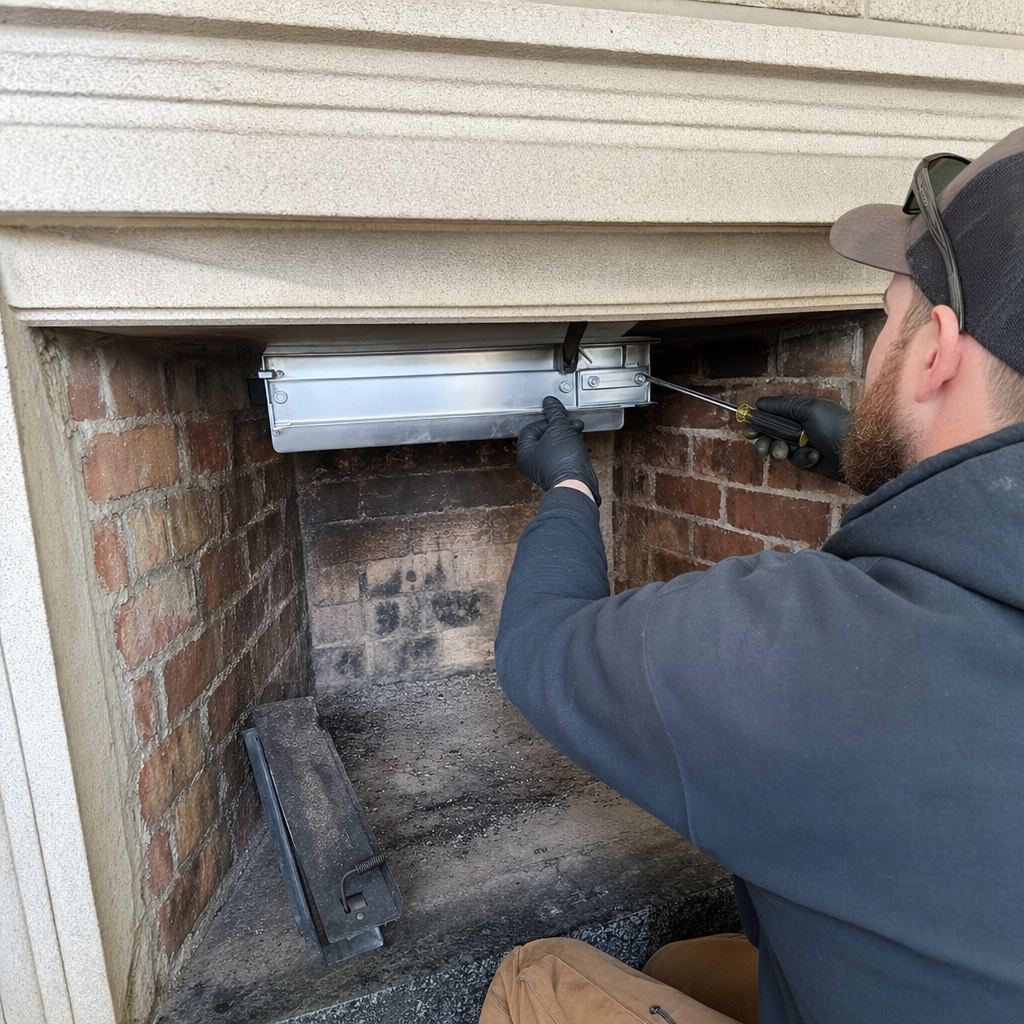
- Firebox inspection. Look for cracked or missing firebrick, deteriorated mortar joints, and rust stains on the back wall (indicates water entry from above). In Buffalo’s older housing stock — think Elmwood Village duplexes and West Side Victorians — we’ve seen firebrick degraded to powder from decades of moisture infiltration.
- Damper operation. Open and close the damper fully. It should seat cleanly without grinding or catching. A damper that won’t close completely wastes 8-10% of your heating dollars through summer and winter alike.
- Smoke chamber check with flashlight. Shine a light up past the damper. The smoke chamber walls should be parge-coated smooth, not rough and corbelled. Rough surfaces collect creosote and reduce draft efficiency.
Attic (If Accessible)
This is where Buffalo homeowners catch problems that living-room inspections miss. Lake-effect snow drives moisture through small crown cracks, and the attic is where that moisture reveals itself.
- Chimney breast inspection. Look for white or gray powder (efflorescence), dark water stains, or spalling brick faces on the attic-side of the chimney. Any of these means water is migrating through the masonry.
- Framing contact points. Check where the chimney passes through attic floor joists. Discolored wood, compressed insulation, or rusted fasteners suggest long-term moisture exposure — a fire safety issue if it reaches the framing.
- Metal liner visibility. If you can see any portion of a metal liner, check for corrosion spots, gaps in joint seams, or dislodged sections. Buffalo’s temperature swings from -10°F to 50°F in a single week stress metal expansion joints aggressively.
Exterior Ground-Level Inspection
Stay on the ground. Use binoculars if you have them.
- Crown condition. The concrete crown at the chimney top should overhang the brick by at least 2 inches with a drip edge underneath. Look for cracks, missing chunks, or pooling areas — all direct water entry paths.
- Cap and spark arrestor. The cap should sit level, not tilted from wind or ice load. Mesh sides should be intact, not rusted through or clogged with creosote flakes.
- Flashing lines. Where the chimney meets the roof, look for lifted, curled, or missing flashing tabs. Buffalo’s ice dam seasons separate flashing from masonry with disturbing regularity.
- Brick and mortar joints. Spalling (flaking brick faces), missing mortar to finger-depth, or leaning sections all need professional evaluation.
Seasonal Trigger Points: April and August Checks
Buffalo’s heating season runs roughly October through April, which creates two natural inspection windows. The April check catches damage accumulated over winter; the August check ensures readiness before the first cold snap.
April: Post-Heating Season Assessment
- Creosote inventory. After a season of use, estimate your buildup. If you burned more than two cords of wood, you likely need sweeping regardless of visual appearance. Buffalo’s dense hardwoods (oak, maple, beech) burn cleaner than softwoods but still produce significant second-degree creosote in slow-burning inserts.
- Ash pit and cleanout door. Empty ash completely — damp ash accelerates metal corrosion over summer. Check that the cleanout door seals tightly; if you smell ash or soot on humid July days, the seal has failed.
- Exterior moisture damage survey. Walk the perimeter after snowmelt. Look for new mortar loss, shifted cap position, or flashing gaps opened by ice expansion. The freeze-thaw cycles of February and March are brutal on Buffalo masonry.
- Document everything. Note burn hours, wood species, and any performance changes. This becomes your maintenance log (see below).
August: Pre-Heating Season Readiness
- Operational test. Open the damper, light newspaper as described above, and confirm draft establishes properly. Summer air pressure patterns differ from winter — a chimney that drafted fine in March may struggle in October due to surrounding foliage or atmospheric changes.
- Cap and crown re-inspection. Summer storms and nesting season (squirrels, starlings, chimney swifts) create new blockage risks. Verify cap mesh is clear and crown has no new cracks from summer thermal cycling.
- Schedule your sweep if needed. September booking windows fill fast in Buffalo. If your April inspection indicated you’d need service, August is when you lock in your appointment.
How to Identify Third-Degree Creosote by Smell and Smoke
Most online guides describe creosote by appearance alone — flaky, puffy, or glazed. After 11 years of opening flues across Buffalo, Thomas has learned that smell and smoke behavior are earlier and more reliable indicators, especially for homeowners who don’t own a chimney camera.
First-Degree Creosote: Sooty, Dry, Ash-Like
Smells like faint campfire when the damper is open. Smoke during burning is light gray and rises cleanly. This is normal for well-seasoned hardwood burned with adequate air supply. Annual sweeping removes it easily.
Second-Degree Creosote: Flaky or Puffy, Black
Smells acrid and sharp — like overheated asphalt or burning plastic — especially when you first open the damper. Smoke may be darker, with occasional brownish tint. Indicates cooler flue temperatures from restricted air, wet wood, or insert over-damping. Requires sweeping; may need chemical treatment if thick.
Third-Degree Creosote: The Danger Zone
This is what Thomas worries about. Third-degree creosote is not just more buildup — it’s a fundamentally different substance. Here’s how to recognize it before you ever shine a light up the flue:
- Smell: A heavy, sweet-tar odor that lingers in the room even when the fireplace is cold and the damper is closed. Some homeowners describe it as “like roofing tar” or “burnt sugar gone wrong.” If you smell this in July with no fire since March, you have significant glazed buildup.
- Smoke behavior: When you do burn, smoke is dense and may appear slightly iridescent or oily. It clings to the firebox walls rather than rising cleanly. You may see actual liquid droplets condensing on cooler surfaces near the opening.
- Visual confirmation (if accessible): Shiny, black, enamel-like glaze that looks poured or painted on, not accumulated. It may have run marks like candle wax. This is essentially condensed wood tar — highly flammable and extremely difficult to remove with brushes alone.
Third-degree creosote in Buffalo is common in older homes with exterior chimneys on north-facing walls, where flue temperatures run cooler. It’s also typical with EPA-certified wood stoves operated in their lowest air settings for overnight burns. If you suspect third-degree buildup, don’t attempt to burn it off — chimney fires from glazed creosote reach 2,000°F and can crack liners or ignite adjacent framing. Call for professional evaluation and possible chemical treatment with PCR (Post Creosote Remover) or mechanical removal.
Gas Fireplace Inserts vs. Wood Stove Inserts: Different Maintenance Rhythms
Buffalo homeowners often assume “insert” means one thing. The maintenance requirements diverge sharply, and mixing them up leaves dangerous gaps.
Gas Fireplace Inserts
Gas inserts burn clean but create their own problems. The ceramic logs degrade and shed particles that clog burner ports. Condensation in the flex liner — especially in Buffalo’s cold exterior chimneys — corrodes metal and damages masonry. Venting systems accumulate spider webs, dust, and insect nests that obstruct flow.
Maintenance rhythm: Professional service every two years minimum, annually if used as primary heat. Between visits, homeowners should:
- Check that pilot flame burns steady blue, not yellow or fluttering
- Verify glass panel seals tightly — any gap draws room air and wastes energy
- Listen for delayed ignition or “whoosh” on startup, indicating dirty burner or pressure problem
- Confirm exterior termination cap is clear of snow, ice, and vegetation (critical after Buffalo’s heavy snow events)
Thomas services gas inserts with specific attention to flex liner integrity — we’ve replaced DuraFlex liners in Hamburg and Orchard Park homes where condensation pooling at the low point rotted the connection within seven years.
Wood Stove Inserts
Wood stove inserts are essentially metal fireplaces inside your fireplace, connected to a stainless liner running to the top. They burn hotter and more efficiently than open fireplaces but concentrate creosote production in the liner rather than the full flue.
Maintenance rhythm: Annual sweeping of the liner mandatory; every cord of wood burned justifies inspection. Homeowner checks:
- Door gasket seal — dollar-bill test: close door on bill, pull; should resist at all points
- Baffle plate position — displaced baffles send flames directly up the flue, accelerating liner wear
- Glass cleaning method — avoid ammonia-based cleaners that etch ceramic glass; use approved stove glass cleaner only
- Ash accumulation in the insert body, not just the firebox — excess ash insulates the firebox floor and warps cast components
The connector pipe from insert to liner is the failure point Thomas sees most in Buffalo. Thermal cycling and vibration loosen the connection; without annual inspection, smoke can leak into the chimney cavity and enter the house through mortar gaps.
The Simple Log That Speeds Up Your Sweep Visit
Professional sweeps spend 15-20 minutes of every appointment asking basic history questions. A simple homeowner log eliminates this time and lets your technician focus on actual problems. After 297 service appointments, Thomas can confirm: homeowners who keep logs get more thorough inspections because we don’t waste appointment time on background.
Here’s the format we recommend — a single page, updated seasonally:
| Entry Date | Wood Species / Gas Hours | Burn Hours (Est.) | Performance Notes | Observed Issues |
|---|---|---|---|---|
| Oct 15, 2024 | Seasoned oak, 2 cords | ~180 hrs | Good draft, clean glass | None |
| Jan 8, 2025 | Same + 1 cord maple | ~320 hrs total | Slower startup on cold days | Faint tar smell at damper |
| Apr 3, 2025 | Season complete | ~410 hrs | Smoke lingered 2-3 min on startup last 2 weeks | White powder on exterior brick, south side |
Bring this to your sweep appointment. The technician knows immediately whether they’re looking at normal first-degree buildup, possible second-degree requiring more aggressive brushing, or third-degree needing chemical pretreatment. For gas inserts, substitute “thermostat setting range” and “pilot outages” for wood-specific columns.
This log also protects you at home sale or insurance claim — documented maintenance history demonstrates due diligence.
Buffalo-Specific Risks: Moisture, Freeze-Thaw, and Lake-Effect Wear
Generic chimney advice ignores the environmental factors that dominate Buffalo’s chimney failure modes. Here’s what 11 years of local work has taught us.
Freeze-thaw masonry destruction: Buffalo averages 52 freeze-thaw cycles annually — days that swing above and below 32°F. Each cycle, water in masonry expands 9% as it freezes. Over a decade, this turns sound brick to spalling fragments and sound mortar to sand. Exterior chimneys on homes in Riverside, Black Rock, and the West Side — neighborhoods with 1920s construction and minimal wall insulation — show this damage most severely. The white efflorescence you see is salt crystallization from evaporating water; it’s not merely cosmetic — it indicates active water migration through the masonry matrix.
Lake-effect snow load on caps and crowns: A single November storm can deposit 3-4 feet of snow on a chimney top. The weight tilts caps, cracks crowns, and blocks flues. After major storms, verify your cap position from the ground — a tilted cap indicates the mounting flange has stressed or the crown beneath has cracked.
Interior moisture from combustion air: Tight modern homes in suburbs like Amherst and Clarence, combined with powerful kitchen and bath exhaust fans, create negative pressure that pulls moist outdoor air down the chimney. This moist air condenses on cool flue surfaces, accelerating liner corrosion and creosote absorption into masonry. If your home was built after 1990 and you have persistent “damp fireplace” smell in summer, this is likely your problem — solvable with a lock-top damper or outside combustion air supply.
Historic clay liner degradation: Pre-1940 Buffalo homes often have unlined brick chimneys or single-wythe clay flue tiles that have cracked from thermal shock. These cannot safely vent modern appliances. If your home is in Allentown, the Elmwood Village, or any neighborhood with pre-war housing and you’ve never had a liner inspection, schedule one — not as upsell, but as safety verification.
Common Mistakes to Avoid
- Assuming gas fireplaces need no maintenance. Buffalo homeowners with gas inserts often skip service for 5-7 years. By then, corroded flex liners and degraded burner assemblies create CO risks and expensive repairs. Biennial service is non-negotiable.
- Burning unseasoned wood because “it’s cheaper.” Green wood at 40-50% moisture content produces three times the creosote of properly seasoned 20% wood. That $50 cord savings becomes a $400 sweep with chemical treatment, or worse, a chimney fire.
- Ignoring smoke spillage that “clears up after a few minutes.” Persistent startup spillage indicates flue sizing problems, chimney height inadequate for local wind patterns, or hidden blockage. In Buffalo’s tight neighborhoods with two-story homes close together, downdraft pressure is real and fixable — but not by waiting.
- DIY sweeping with a hardware-store brush. Polypropylene brushes don’t remove glazed creosote and can damage clay flue tiles. Worse, without a proper inspection camera, you can’t see cracked liners or hidden nest blockages above the smoke chamber. Professional sweeping includes diagnostic inspection — the sweep is only part of the value.
- Putting off crown repair because “it’s just the top.” A cracked crown funnels water directly into the chimney core. In Buffalo’s freeze-thaw climate, water penetration destroys chimneys from the inside out. A $300 crown seal or rebuild prevents $3,000+ masonry reconstruction.
- Assuming all sweeps are the same. Some Buffalo-area services are general handyman operations that added chimney brushes last year. Ask how long they’ve been chimney-only, whether they carry cameras and inspection equipment, and whether the person quoting is the person doing the work. At Titan Chimney Cleaning Greater Buffalo home, Thomas Hernandez answers the phone, bids the job, and performs the work — no rotating subcontractors.
When to Call a Professional
Call immediately if you observe: smoke entering the room during normal operation; visible flames or glowing material in the flue outside the firebox (chimney fire); sudden draft reversal with no weather explanation; fallen bricks or mortar at the chimney base; or carbon monoxide detector activation with no other source identified.
Schedule evaluation within two weeks for: persistent third-degree creosote indicators (tar smell, glazed appearance); new efflorescence or water staining; damper malfunction; cracked firebrick; or any gas insert performance change (delayed ignition, sooting, odor).
Titan Chimney Cleaning Greater Buffalo offers free estimates in Buffalo — call (833) 632-3568. Thomas Hernandez serves as lead technician on every job, from routine Chimney Cleaning & Sweep in Buffalo to full liner replacement with professional-grade materials. With 297 verified reviews averaging 4.7 stars and 11 years of chimney-only focus, we’ve built our reputation on showing up personally and fixing problems completely.
Frequently Asked Questions
Standard chimney sweeping in Buffalo typically ranges from $200-$350 for a routine maintenance cleaning, with third-degree creosote removal or insert liner sweeping running $400-$650 depending on accessibility and buildup severity. For full details, see The Complete Guide to Chimney Cleaning in Buffalo. Gas fireplace service generally falls between $150-$275. Call (833) 632-3568 for an exact quote — estimates are free, and Thomas Hernandez evaluates each chimney personally rather than applying flat rates that miss your specific conditions.
Wood-burning fireplaces and wood stove inserts need annual sweeping if used as primary or significant secondary heat; gas fireplace inserts need professional service every two years. In Buffalo’s climate, exterior chimneys and those venting inserts into unlined flues may need more frequent attention due to condensation and creosote acceleration from cold-start conditions.
Homeowners can and should perform the ground-level, room-by-room inspections in this guide twice yearly — they’re your early warning system. However, internal flue inspection requires specialized camera equipment and training to identify cracked liners, hidden creosote buildup, and combustion chamber defects that aren’t visible from the firebox. Think of homeowner inspection as monthly blood pressure checks and professional sweeping as the annual physical with lab work. For help choosing a qualified professional, read How to Hire a Chimney Cleaning Contractor in Buffalo: A Step-by-Step Guide.
A sweep is the physical cleaning of flue deposits and combustion residue. An inspection is the diagnostic evaluation of the entire system — liner, crown, cap, flashing, firebox, smoke chamber, and exterior — for safety and performance. In our Chimney Cleaning & Sweep in Buffalo service, every sweep appointment includes a Level 1 inspection as standard; Level 2 inspections with camera evaluation are recommended when buying a home, after chimney fires, or when changing appliance types.
Summer chimney odor in Buffalo usually indicates one of three problems: creosote buildup absorbing humidity and releasing tar compounds; negative house pressure drawing moist outdoor air down the flue; or animal entry leaving organic material. The specific smell helps diagnose — sharp and chemical suggests creosote; musty and organic suggests animals or moisture; sour and stagnant suggests blocked drainage or water pooling. A lock-top damper, proper sweeping, or crown repair typically resolves the root cause.
Localized damage to stainless steel liners can sometimes be repaired with HeatShield cerfractory sealant or section replacement, typically 40-60% less than full replacement. However, clay tile liners with multiple cracks, shifted sections, or glaze damage usually require complete replacement with a stainless steel or DuraFlex relining system. Thomas evaluates liner condition with video inspection and recommends repair only when it provides durable, code-compliant performance — we won’t patch a liner that needs replacement.
Standard sweeping and many repairs can be completed same-day if scheduled in advance. Emergency blockage removal, cap replacement, and some Chimney Repair in Buffalo services are available with priority scheduling during heating season. Full liner replacements and crown rebuilds require measurement and material ordering — typically 3-5 business days for standard sizes, longer for custom configurations. Call (833) 632-3568 to discuss urgency and availability.
The Bottom Line
Buffalo’s climate is hard on chimneys — freeze-thaw cycles, lake-effect moisture, and extended heating seasons create problems that generic maintenance advice misses. The homeowners who avoid expensive surprises aren’t the ones with the newest fireplaces; they’re the ones who inspect systematically in April and August, recognize creosote stages by smell and behavior, keep simple maintenance logs, and call before small defects demand major reconstruction. This checklist gives you the observation skills to know when something’s changed. For more guides & resources, visit our blog. The next step is acting on that knowledge promptly — because in 11 years of Buffalo chimney work, Thomas has never once had a homeowner regret calling too early.
Written by Thomas Hernandez, Owner & Lead Technician at Titan Chimney Cleaning Greater Buffalo, serving Buffalo since 2015.