
Last updated July 15, 2026
Seasonal Chimney Cleaning Care for Buffalo: Year-Round Homeowner’s Guide
Here’s what most Buffalo homeowners get wrong: they wait until the first cold snap in October to think about their chimney. By then, every reputable sweep in Western New York is booked three weeks out, and you’re choosing between a rushed job or a cold living room. In our 11 years working exclusively on chimneys across Buffalo, we’ve learned that the homeowners with the safest, most efficient fireplaces treat chimney care as a year-round discipline — not a fall panic. This guide — a companion to our complete guide to chimney cleaning in Buffalo — breaks down exactly what your chimney needs during each of Buffalo’s distinct seasons, why July is secretly the most important month on your maintenance calendar, and how your burning habits should reshape your entire schedule.
Quick Answer
Buffalo homeowners should schedule chimney maintenance four times per year: a post-winter damage inspection in April, major repairs and liner work during the dry summer months of June through August, a pre-heating-season sweep and safety check in September, and ongoing creosote monitoring throughout the burning season from November to March. Skipping any of these windows — especially the summer repair season — leads to higher costs, longer wait times, and increased fire risk when temperatures drop.
Table of Contents
- Spring (April–May): Assessing Freeze-Thaw Damage After Buffalo’s Hard Winter
- Summer (June–August): The Hidden Prime Season for Chimney Work
- Fall (September–October): The Pre-Season Sweep and Why First Fires Fail
- Winter (November–March): Safe Burning and When to Stop Immediately
- How Your Burning Habits Change Your Maintenance Calendar
- Why Buffalo’s Lake-Effect Climate Demands a Different Approach
- Common Mistakes to Avoid
- When to Call a Professional
- Frequently Asked Questions
Spring (April–May): Assessing Freeze-Thaw Damage After Buffalo’s Hard Winter
Buffalo’s winter doesn’t just dump snow — it tortures masonry. Temperatures swing from single digits to above freezing dozens of times per season, and every swing forces moisture inside your brick and mortar to expand and contract. By April, that cycle has done real damage that a visual inspection from the ground won’t catch.
In our experience across neighborhoods from North Buffalo to South Buffalo, and out through West Seneca and Amherst, spring reveals three predictable problems:
- Spalling brick — The freeze-thaw cycle pops the face off bricks, leaving porous cores exposed to more water intrusion. We’ve pulled handfuls of crumbled brick from flues in Parkside homes that looked fine from the outside.
- Crown cracking — The concrete slab at your chimney’s top takes the worst of Buffalo’s weather. Hairline cracks in October become quarter-inch gaps by April, funneling water straight down the flue.
- Flue tile deterioration — Clay flue liners expand and contract at different rates than surrounding brick. After a hard Buffalo winter, we’ve found shifted or cracked tiles in roughly 30% of the inspections we perform in April and May.
Here’s why post-winter inspection matters more than pre-winter in Buffalo specifically: our spring rains are relentless. A compromised chimney cap or cracked crown that survived winter dry air will fail under May’s sustained precipitation. Water in your flue during warm months breeds mold, accelerates metal rust, and weakens mortar joints before you’ve even thought about lighting a fall fire.
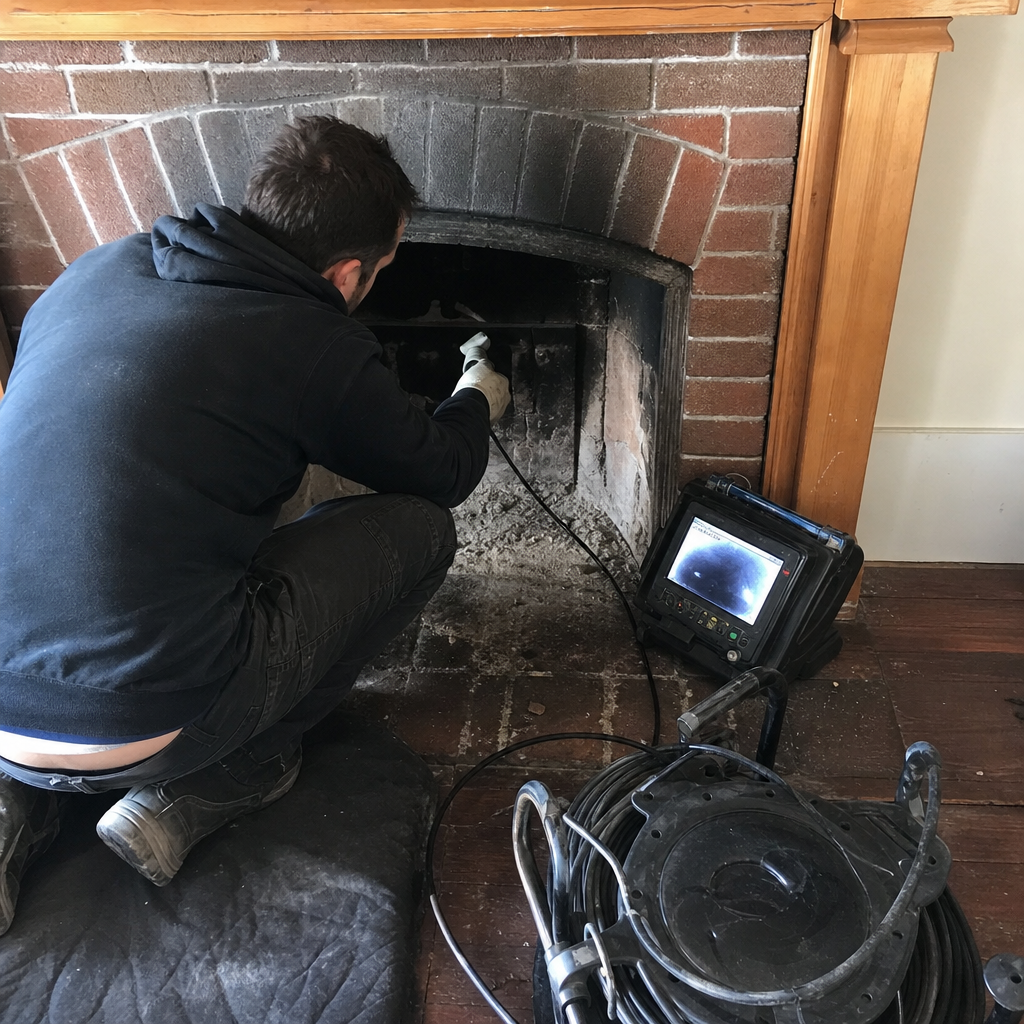
What we do in spring: a camera inspection of the full flue length, moisture assessment of the firebox and smoke chamber, and documentation of any crown or masonry damage. If we find issues, summer becomes the repair window — not fall, when you’re competing with every other Buffalo homeowner who waited.
Summer (June–August): The Hidden Prime Season for Chimney Work
July is the single most overlooked chimney maintenance window in Buffalo. The flue is fully dry after months of disuse. The temperature inside the chimney is comfortable to work in. Most importantly, you’re not competing with the October rush that backs up every reputable sweep from Hamburg to Lockport.
We schedule our most complex work — the jobs that require real time and attention — during these months. Here’s what belongs on your chimney cleaning & sweep maintenance checklist for Buffalo homeowners:
- Liner replacement or relining — Installing a stainless steel liner from a professional-grade manufacturer like DuraFlex or Olympia Chimney requires a dry, accessible flue. Summer humidity in Buffalo is manageable, and the liner cures properly without the thermal shock of winter temperature differentials. We’ve completed full liner replacements in Kenmore and Tonawanda during July that would have taken twice as long in October conditions.
- Tuckpointing and masonry repair — Repointing mortar joints demands dry surfaces and moderate temperatures. Buffalo’s summer window is shorter than it looks — we aim to complete exterior masonry work before late August, when humidity spikes and afternoon thunderstorms become unpredictable.
- Cap and crown installation — A properly fitted cap from Famco or Copperfield prevents the exact water intrusion that destroys flues. Summer installation means the sealants cure fully before fall rains, and you’re not risking a rushed measurement because the crew is trying to fit five jobs into a shortened October day.
- Full rebuilds — When a chimney has suffered catastrophic freeze-thaw damage or structural settling, summer is the only practical season for teardown and rebuild. We’ve rebuilt chimneys in the Elmwood Village and North Tonawanda during July and August that would have been impossible to protect from weather once September arrived.
The scheduling advantage is real. In our 11 years serving Buffalo, our average lead time for non-emergency work in July is 5–7 days. By mid-October, that stretches to 3–4 weeks. Homeowners who book summer appointments get Thomas Hernandez’s full attention on their timeline — not whatever window remains after the rush.
Fall (September–October): The Pre-Season Sweep and Why First Fires Fail
Statistically, the first fire of the heating season is the most dangerous. After months of disuse, creosote deposits from last winter remain in the flue. Nesting materials from summer — birds, squirrels, raccoons love unused chimneys — create immediate blockages. And homeowners, eager for warmth, often skip the inspection they should have done in spring or summer.
Our pre-season sweep in Buffalo follows a specific protocol:
- Full mechanical sweep of the flue from firebox to crown, using professional-grade brushes sized to your specific flue diameter — not the one-size-fits-all tools that miss corners in square tile liners.
- Camera inspection to verify flue integrity, check for new cracks or deterioration, and confirm no obstructions remain.
- Firebox and damper assessment — The damper that sealed reasonably well last March may be stuck or warped after a humid Buffalo summer. We test full range of motion and seal quality.
- Exterior cap and crown check — Even if you inspected in spring, summer storms and animal activity can create new damage.
- Combustion clearance verification — We confirm mantel clearances, hearth dimensions, and nearby combustible materials meet current standards. Buffalo’s older housing stock, especially in neighborhoods like Allentown and the West Side, often has fireplaces built to codes that predate modern safety requirements.
Here’s the reality of Buffalo’s fall schedule: by the time you feel cold enough to want a fire, every competent chimney professional is already overbooked. The homeowners who get thorough, unhurried pre-season service are the ones who called in August or early September. The October callers get whatever time remains — and in our experience, rushed chimney work is how safety details get missed.
Chimney Cleaning & Sweep in Buffalo should be booked before you need it, not when you’re already cold.
Winter (November–March): Safe Burning and When to Stop Immediately
Buffalo’s heating season runs long — typically late October through April, with serious cold arriving by Thanksgiving and lingering past Easter. During these months, your chimney is working hardest and you’re least able to schedule major repairs. The goal shifts from prevention to vigilant operation.
What homeowners can safely monitor between professional visits:
- Creosote buildup rate — Check your firebox weekly for glazed, shiny black deposits. A thin layer of soot is normal; thick, tarry buildup means your wood is too wet or your fires are too cool. In Buffalo’s humid winter air, improperly seasoned wood can jump from 20% moisture to 30% in weeks if stored outside.
- Draft quality — Smoke lingering in the firebox or rolling into the room on startup indicates a cold flue, blocked cap, or negative pressure from your home’s HVAC system. Cold air pooling in an exterior chimney — common in Buffalo’s below-zero stretches — can reverse draft entirely until the flue warms.
- Exterior masonry condition — From the ground, look for new white efflorescence (mineral deposits from water migration), missing mortar, or displaced cap pieces. These are early warnings that freeze-thaw damage is active.
- Animal sounds or debris — Scratching, chirping, or organic debris in the firebox means an active intrusion. Stop using the fireplace until it’s cleared — nests ignite fast.
Safety caveat: Some winter chimney problems require immediate professional attention and complete fireplace shutdown. Do not attempt to diagnose or repair these yourself:
- Visible flames or glowing material anywhere outside the firebox (chase fires, exterior masonry ignition)
- Smoke entering rooms on any floor, indicating a breached flue or severe blockage
- Cracking or popping sounds from within walls or chimney structure during a fire
- Carbon monoxide detector activation — treat every alarm as a chimney or venting emergency
- Collapsed or visibly damaged flue liner, which can allow combustion gases into wall cavities
These are not maintenance issues — they’re immediate hazards. Call a professional and stop using the system until it’s inspected. (See our guide to chimney cleaning permits, codes & inspections in NY for what qualified pros must verify.) In Buffalo’s tight housing stock, a compromised flue doesn’t just risk your home; it risks attached properties and multi-unit buildings.
How Your Burning Habits Change Your Maintenance Calendar
Not all fires are equal, and Buffalo homeowners burn a mix that affects how often their chimneys need attention. Your fuel type should reshape your entire maintenance schedule:
Cord wood (hardwood, properly seasoned)
The traditional Buffalo fuel — oak, maple, beech, often sourced from Erie County or Southern Tier suppliers. Even well-seasoned hardwood produces creosote, especially when fires are banked overnight for long, slow burns. We recommend:
- Annual sweep for moderate use (2–3 fires weekly)
- Mid-season inspection for heavy use (daily fires through January and February)
- Spring inspection mandatory — the creosote you deposited in February is acidic and corrosive all summer
Manufactured logs (Duraflame, etc.)
Lower creosote production but not zero. These logs burn hotter and faster, which can thermal-shock older flue tiles. We’ve seen more cracked flue tiles in gas-to-wood-converted fireplaces where homeowners switched to manufactured logs without adjusting their inspection schedule. Annual sweep still required; don’t extend intervals based on marketing claims.
Gas inserts and log sets
Cleaner burning but not maintenance-free. Gas produces water vapor as a primary combustion byproduct, and in Buffalo’s cold chimneys, that vapor condenses on flue walls, mixing with any residual soot to form sulfuric acid. Ceramic logs degrade and can block ports. Venting systems — especially direct vents and B-vents — require specific clearances that shift during freeze-thaw cycles. We inspect gas fireplaces annually, with particular attention to:
- Log placement and condition
- Vent termination clearance and obstruction (snow and ice in Buffalo are common blockages)
- Gas valve and pilot assembly function
- Carbon monoxide spillage testing
Fireplace Services in Buffalo covers the full range of fuel types and venting systems.
Pellet stoves
Require the most frequent professional attention of any solid fuel. The exhaust path is narrow and precise; ash accumulation is constant; and the combustion blower demands clean airflow. We recommend professional service every 1–2 tons of pellets burned — typically mid-season for Buffalo homeowners heating with pellets as a primary source.
Why Buffalo’s Lake-Effect Climate Demands a Different Approach
Chimney advice written for generic “cold climates” fails in Buffalo because it doesn’t account for lake-effect moisture, our specific freeze-thaw frequency, and our housing age distribution.
Moisture load: Lake Erie and Ontario keep Buffalo’s air humid year-round. Summer humidity slows masonry drying after rain; winter lake-effect snow packs against chimneys and melts into masonry on every temperature swing. A chimney in dry Minneapolis faces different challenges than one in Hamburg or Orchard Park, where sustained moisture exposure is the norm.
Freeze-thaw frequency: Buffalo averages 50–60 freeze-thaw cycles per winter — days where temperatures cross 32°F. Each cycle pumps water through masonry pores. Pittsburgh or Cleveland get cold; Buffalo gets cold with violent oscillation. That specific pattern destroys crowns, spalls brick, and separates flashing faster than sustained cold alone.
Housing stock age: Buffalo’s core neighborhoods — North Buffalo, Elmwood, Allentown, the East Side — contain thousands of homes built before 1940 with original chimneys. These systems were designed for coal or early oil heating, then adapted for wood or gas. Their flue dimensions, liner configurations, and structural clearances often don’t match modern appliance requirements. We’ve found unlined brick flues still in service in Parkside homes, and clay tile liners from the 1950s crumbling in Cheektowaga ranches. Generic maintenance schedules don’t account for this accelerated aging.
Neighborhood-specific issues: In older areas with mature tree canopy — Grant Ferry, parts of South Buffalo — animal intrusion is more frequent. In lakefront communities like Lackawanna and Blasdell, wind-driven rain and salt exposure accelerate metal component corrosion. Near the airport and industrial corridors, particulate loading can be higher, affecting cap and screen clogging rates.
This is why we don’t use a one-size-fits-all inspection protocol. Thomas Hernandez adapts each inspection to the home’s age, location, fuel type, and observed condition — not a checklist developed for a different climate.
Common Mistakes to Avoid
- Waiting for fall to schedule anything — By October 15, Buffalo’s chimney professionals are booked through Thanksgiving. The homeowners who get thorough fall service called in August or September. Summer scheduling isn’t just convenient; it’s how you avoid rushed work.
- Assuming gas fireplaces need no maintenance — Buffalo’s gas fireplace owners often skip annual service, assuming “clean burn” means “no service needed.” Water vapor condensation, degraded ceramic logs, and vent blockages from ice and snow create real hazards. We’ve responded to carbon monoxide calls in Amherst and Clarence that traced directly to neglected gas venting.
- Burning unseasoned wood — “Seasoned” in Buffalo’s humid climate means 12+ months under cover, not 6 months in a backyard pile. Wood at 25% moisture or higher produces massive creosote deposits and burns inefficiently. We can spot the unseasoned-wood homeowners immediately: thick, glazed creosote and complaints about “the fireplace just doesn’t heat well.”
- Ignoring the chimney cap — A missing or damaged cap is an open invitation for water, animals, and debris. In Buffalo’s climate, an uncapped flue accumulates significant water damage in a single season. Caps from professional manufacturers like Gelco or Copperfield are purpose-built for our weather, not decorative afterthoughts.
- DIY creosote removal with chemical logs or brushes — Chemical logs reduce light soot but don’t remove glazed creosote. Consumer-grade brushes are rarely sized correctly and can damage clay tile or miss stainless liner corners. More critically, homeowners working on roofs or with extension ladders in Buffalo’s icy conditions risk serious injury. We’ve been called after DIY attempts that damaged liners or left dangerous deposits in place.
- Treating all sweeps as equivalent — Buffalo has general handymen who added chimney brushes to their trucks, franchise operations that send whichever technician is available that day, and owner-operated specialists. The difference shows in inspection thoroughness, repair quality, and accountability when something goes wrong. In 11 years of exclusive chimney focus, we’ve corrected work from all three categories — and the pattern is consistent.
- Skipping post-winter inspection — The damage Buffalo’s winter inflicts on chimneys is often invisible from the ground and doesn’t cause immediate symptoms. By the time you notice a problem in fall, water has been degrading your system for months. Spring inspection catches damage when it’s smaller, cheaper, and fixable on your summer schedule.
When to Call a Professional
Call a chimney professional immediately if you see smoke entering your living space, hear animal activity in the flue, find debris in the firebox, or notice exterior masonry damage after storms. Schedule preventive service when you’re approaching a new burning season, after any chimney fire event, or if it’s been more than 12 months since your last professional inspection — regardless of how little you’ve used the fireplace.
For major repairs — liner replacement, crown rebuilding, tuckpointing, or structural rebuilds — summer scheduling in Buffalo provides the best conditions, shortest lead times, and most thorough workmanship.
Chimney Repair in Buffalo spans the full scope from cap installation to complete rebuilds, with Thomas Hernandez personally overseeing every project.
Titan Chimney Cleaning Greater Buffalo offers free estimates throughout Buffalo and surrounding communities — call (833) 632-3568 to schedule at whatever point you’re at in your maintenance cycle.
Frequently Asked Questions
Most Buffalo homeowners need an annual professional sweep and inspection, with heavy wood burners or pellet stove users benefiting from mid-season checks as well. The National Fire Protection Association recommends annual inspection for all solid-fuel systems regardless of use level, and in Buffalo’s freeze-thaw climate, that annual check is particularly important for catching moisture-related deterioration. Call (833) 632-3568 to schedule — estimates are free.
A standard sweep and inspection for a single-flue system in the Buffalo market typically runs between $200 and $350, depending on accessibility, flue condition, and whether a camera inspection is included. Repairs, liner work, and rebuilds vary widely based on scope. We provide upfront written estimates before any work begins, and we don’t upsell services you don’t need. Nearly 300 homeowners have trusted us across 11 years because our pricing is straightforward — call for your specific quote.
Repair is sometimes possible with systems like HeatShield for minor clay tile deterioration, but severely cracked, shifted, or missing tiles require full stainless steel liner replacement for safety and code compliance. In Buffalo’s climate, we’ve found that partial repairs to damaged liners often fail within 2–3 years as freeze-thaw cycles continue their work. A professional-grade stainless liner from DuraFlex or Olympia Chimney, properly installed, typically lasts 15–20 years and provides better draft performance. We’ll show you camera footage of your specific flue condition and explain both options honestly.
We prioritize same-day response for active safety hazards — smoke spillage, suspected chimney fires, carbon monoxide concerns, and structural damage that makes the system unsafe to use. For non-emergency maintenance, our schedule varies by season: typically 5–7 days in summer, 1–2 weeks in early fall, and 3–4 weeks during the October rush. The best way to avoid waiting is to book your annual service in July or August, when Buffalo chimneys are dry and our calendar is open. Call (833) 632-3568 and we’ll get you scheduled.
Buffalo’s spring rains are more sustained and penetrate smaller openings than winter snow. A crown with hairline cracks or flashing with minor separation may shed snow adequately but fail under hours of spring rainfall. Additionally, freeze-thaw damage accumulated over winter opens new pathways for water in March and April that didn’t exist in November. Spring is when hidden winter damage reveals itself — which is exactly why we recommend post-winter inspection.
A properly engineered chimney cap is essential protection in Buffalo’s climate, not decoration. It blocks rain and snow entry, prevents animal nesting (squirrels, raccoons, and starlings are active chimney invaders in Western New York), and reduces downdrafts that blow smoke into your home during our windy lake-effect weather. We install caps from professional manufacturers like Famco and Copperfield that are spec’d for our snow loads and wind exposure — not the lightweight hardware-store versions that fail within a few seasons.
The Bottom Line
Buffalo’s chimney maintenance calendar has four distinct phases: spring inspection for freeze-thaw damage, summer for major repairs and liner work, fall for pre-season sweep and safety verification, and winter for vigilant, informed burning. Skip any phase and you pay in safety risk, repair cost, or scheduling frustration. The homeowners with the safest, most efficient systems aren’t the ones who spend the most — they’re the ones who treat chimney care as year-round discipline and use the July maintenance window that everyone else ignores. In 11 years of exclusive chimney work across Buffalo, that pattern hasn’t changed.
Ready to get your chimney on a proper year-round schedule? Explore more guides & resources or call today: Call (833) 632-3568 for a free estimate. Thomas Hernandez personally handles every inspection and repair, and we’ll recommend only the work your specific system needs — no surprise upsells, no subcontracted crews, just 11 years of chimney-only expertise applied to your home.
Titan Chimney Cleaning Greater Buffalo home
Written by Thomas Hernandez, Owner & Lead Technician at Titan Chimney Cleaning Greater Buffalo, serving Buffalo since 2015.