
Last updated July 15, 2026
The Complete Guide to Chimney Cleaning in Buffalo
Most chimney fires in Buffalo don’t start in December — they start in September, the first cold night a homeowner lights a fire in a flue that sat wet and untouched all summer. After 11 years of climbing roofs across Western New York, we’ve learned that Buffalo’s lake-effect moisture and brutal freeze-thaw cycles create chimney conditions you won’t find in a generic national guide. In this guide, you’ll learn how our local climate accelerates creosote buildup, why heavy wood-burners in Buffalo often need more than annual sweeps, what a proper sweep actually includes versus the bare-minimum “brush and go” jobs we see too often, and how to read inspection results that could save your home. For seasonal chimney cleaning care for Buffalo, check our year-round homeowner’s guide.
Quick Answer
Professional chimney cleaning in Buffalo, NY costs between $180 and $350 for a standard Level 1 sweep with inspection, and should be performed annually for average use — twice yearly for homes burning more than three cords of hardwood per season. A proper Buffalo chimney sweep includes a full flue brushing, smoke chamber and firebox inspection, damper check, and debris removal, taking 60–90 minutes for a typical single-flue system. Because Buffalo’s lake-effect humidity and extended heating season accelerate creosote stage progression, local homeowners face higher risks than those in drier climates if maintenance lapses.
Table of Contents
- How Buffalo’s Climate Destroys Chimneys Faster Than Drier Regions
- What a Full-Service Chimney Sweep Actually Includes (Step by Step)
- Level 1 vs. Level 2 Inspections: What Buffalo Homeowners Need to Know
- Creosote Stages and Why Buffalo’s Moisture Accelerates Buildup
- Masonry Damage Patterns We See in Buffalo’s Older Housing Stock
- How Often Should You Clean Your Chimney in Buffalo?
- Chimney Cleaning Costs in Buffalo: What to Expect
- Choosing a Chimney Sweep in Buffalo: Red Flags and Green Lights
How Buffalo’s Climate Destroys Chimneys Faster Than Drier Regions
Buffalo’s position on Lake Erie creates a chimney environment that’s fundamentally different from inland cities. Lake-effect humidity keeps masonry saturated for longer periods, and our freeze-thaw cycles — sometimes dozens per winter — exploit every tiny crack in mortar and flue tile.
Here’s what happens inside a Buffalo chimney that doesn’t happen the same way in, say, Rochester or Syracuse:
- Extended moisture exposure: Lake-effect clouds and precipitation keep chimney exteriors wetter, longer. That moisture wicks into masonry, and when temperatures drop below freezing overnight, water expands by 9% — prying apart mortar joints and flue tiles with mechanical force.
- Delayed drying season: In Buffalo, chimneys often don’t fully dry out until late June. A flue that sat damp through May and June has been hosting acidic condensation on creosote deposits for months, accelerating corrosion of metal components and degrading clay tile.
- Longer active burning periods: Our heating season routinely stretches seven months, from October through April. More burn hours means more creosote accumulation per calendar year compared to milder climates.
- Rapid temperature swings: A 40-degree drop in 12 hours isn’t unusual in Buffalo. Thermal shock stresses liner materials, especially in older clay tile systems common in pre-1970s housing stock in North Buffalo, Elmwood Village, and the West Side.
In our experience, a chimney in Buffalo’s repair-heavy environment degrades roughly 30% faster than comparable construction in drier Upstate regions. That’s not speculation — it’s what we see when we open up flues in Riverside versus comparable-age homes we’ve worked on in drier climates.
The September fire risk we mentioned? It comes from homeowners who assume their chimney is “fine” after a wet summer, not realizing that moisture has transformed Stage 1 creosote into harder, more combustible Stage 2 or 3 deposits. The first hot fire of autumn ignites what the summer humidity prepared.
What a Full-Service Chimney Sweep Actually Includes (Step by Step)
There’s a world of difference between a proper sweep and the “brush and go” services that leave Buffalo homeowners with false confidence. After 11 years exclusively in this trade, we’ve developed a systematic approach that addresses the specific conditions our climate creates.
Here’s exactly what happens when Thomas shows up personally for a standard sweep:
- Exterior assessment: We inspect the chimney crown, cap, flashing, and visible masonry from the roof or ladder. In Buffalo, we’re looking specifically for freeze-thaw damage, spalling brick, and deteriorated mortar joints that let water into the flue system.
- Interior setup: Drop cloths protect your flooring. We seal the fireplace opening with a high-powered HEPA vacuum connection to contain all soot and debris — no mess in your living space.
- Flue brushing: Using professional-grade poly or wire brushes sized to your flue diameter, we mechanically remove creosote deposits from the full length. For Buffalo’s heavier buildup patterns, we may use rotary cleaning systems with flexible rods that navigate offset flues common in older homes.
- Smoke chamber and firebox cleaning: The smoke chamber above the damper and the firebox floor receive hand-brushing and vacuuming. These areas collect falling debris and contribute to draft problems if neglected.
- Damper inspection and function test: We check for proper opening, closing, and sealing. A stuck or warped damper in Buffalo’s climate often indicates moisture damage that needs fireplace service attention.
- Level 1 inspection: We examine all readily accessible portions of the chimney structure and flue for cracks, deterioration, blockages, and proper clearances to combustibles.
- Documentation: Photos of findings, written condition report, and clear recommendations for any needed repairs or follow-up inspections.
- Cleanup and walkthrough: We leave your space cleaner than we found it and explain what we found in plain terms — no jargon, no pressure.
The entire process takes 60–90 minutes for a typical single-flue system. Compare this to the 20-minute “sweeps” we’ve seen from itinerant operators who brush the flue, skip the inspection, and leave homeowners with a receipt and a gamble.
Level 1 vs. Level 2 Inspections: What Buffalo Homeowners Need to Know
Not every chimney check is the same. The National Fire Protection Association (NFPA) defines three inspection levels, but most Buffalo homeowners encounter only Level 1 and Level 2. Understanding the difference — along with chimney cleaning permits, codes & inspections in NY — protects you from both under-service and unnecessary upsells.
Level 1 Inspection is the standard annual check for chimneys with no changes, no known problems, and continued use of the same appliance. It covers readily accessible portions of the chimney exterior, interior, and connections. For Buffalo homeowners with normal use patterns and no recent events, this is appropriate.
Level 2 Inspection is required when:
- You’re buying or selling a home (mandatory in most real estate transactions)
- you’ve changed your fuel type or appliance
- You’ve had a chimney fire, earthquake, or significant weather event
- You’ve made structural modifications to the building
- Your Level 1 inspection reveals suspected hidden hazards
Level 2 includes everything in Level 1 plus video scanning of the flue interior and inspection of accessible attics, crawl spaces, and basements. In Buffalo’s older housing stock — think Allentown, Fruit Belt, or the pre-war homes in Kaisertown — we recommend Level 2 for any first-time client because hidden flue damage from decades of freeze-thaw cycling is so common.
Here’s when we specifically recommend upgrading from Level 1 to Level 2 in Buffalo:
- Any home built before 1970 with original clay tile liner (common in North Buffalo and Delaware District)
- Homes with no documented sweep history
- Properties within two miles of Lake Erie where wind-driven moisture exposure is highest
- Chimneys showing exterior spalling, staining, or vegetation growth
We’ve found cracked flue tiles hidden behind seemingly sound exteriors in dozens of Buffalo homes. Video inspection reveals what eyes cannot.
Creosote Stages and Why Buffalo’s Moisture Accelerates Buildup
Creosote isn’t just “soot.” It’s a combustion byproduct that progresses through three distinct stages, each more dangerous and harder to remove. Buffalo’s humid climate pushes chimneys through these stages faster than national averages suggest.
Stage 1: Fine, dusty, black soot. Easily removed with standard brushing. In dry climates, wood-burners might stay at this stage with proper seasoning. In Buffalo, our humidity causes Stage 1 to compact and transform within a single burning season if wood moisture content exceeds 20%.
Stage 2: Crunchy, porous flakes or chips. Requires more aggressive mechanical cleaning. We see this frequently in Buffalo chimneys where homeowners burn “next year” wood — partially seasoned hardwood that arrived green from local suppliers.
Stage 3: Glazed, tar-like, highly combustible “chimney tar.” Removal requires specialized chemicals and rotary equipment. Stage 3 creosote can ignite at temperatures as low as 451°F — well within normal operating temperatures. In Buffalo, we encounter Stage 3 more often than sweeps in arid regions because moisture catalyzes the chemical transformation from Stage 2.
The Buffalo-specific acceleration factors:
- Wet wood culture: Local firewood suppliers sometimes sell “seasoned” wood that’s barely below 30% moisture. We keep a moisture meter on the truck and show homeowners readings — it’s often eye-opening.
- Cold starts: Buffalo homeowners tend to start fires in cold flues (below 40°F), which produces more incomplete combustion and heavier creosote deposition. A warm air preheat or smaller kindling start reduces this.
- Restricted burning: EPA-certified stoves burn cleaner but cooler flue gases can condense more creosote in exterior chimneys exposed to Buffalo’s wind chill. The chimney’s exterior temperature matters as much as the fire’s.
For heavy wood-burners in Buffalo — those burning more than three cords of oak, maple, or beech per season — we often recommend mid-season checks. The standard “annual sweep” advice from national organizations assumes average conditions. Buffalo’s aren’t average.
Masonry Damage Patterns We See in Buffalo’s Older Housing Stock
Buffalo’s architectural heritage is stunning — Victorian mansions in Delaware District, Craftsman bungalows in North Park, brick colonials in South Buffalo. But many of these homes carry original chimney systems never designed for modern heating appliances or 120 years of lake-effect weather.
These are the damage patterns Thomas encounters repeatedly:
Spalling brick from freeze-thaw saturation: Brick faces flake off like shaling skin. We see this most on chimneys without proper caps or with deteriorated crowns, where water enters the masonry matrix and winter freezing pops the surface. In Buffalo, a missing cap can destroy a chimney shoulder in three to five years.
Shaling flue tiles: Thin, curved pieces of clay tile found in the firebox — evidence that the flue liner is deteriorating and exposing combustible framing to heat. In pre-1970s Buffalo homes with original liners, this is increasingly common as thermal cycling fatigue accumulates.
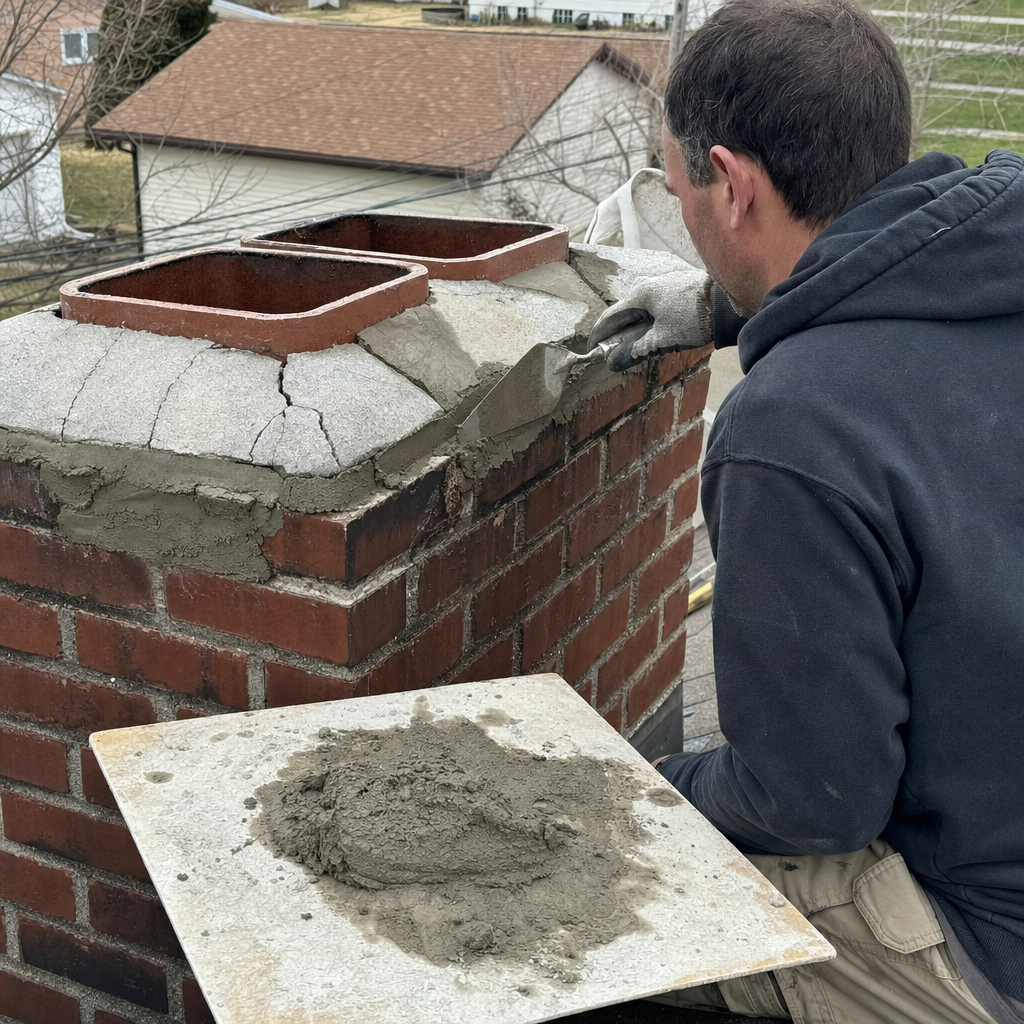
Crown cracks and deterioration: The concrete crown is your chimney’s umbrella. Buffalo’s temperature swings cause crowns to crack, then water enters and accelerates decay. We install Gelco and Copperfield crown seal products and rebuild crowns with proper overhang and drip edges — details that matter in our climate.
Flashing failures at roof lines: Ice damming in Buffalo pulls flashing away from chimney stacks. Water follows the path of least resistance into attics and walls. We inspect this on every exterior assessment.
Efflorescence and staining: White powdery deposits indicate water moving through masonry. In Buffalo’s older homes with lime-based mortars, this signals active moisture intrusion that will eventually compromise structural integrity.
These aren’t cosmetic issues. A spalling chimney in Buffalo’s wind-driven rain environment becomes a water injection system into your home’s structure. We’ve seen collapsed chimney breasts and rotted framing that started with ignored spalling.
How Often Should You Clean Your Chimney in Buffalo?
The NFPA standard is annual inspection, with cleaning “as needed.” But “as needed” varies dramatically by use, fuel, and — critically — local climate.
Here’s our Buffalo-specific guidance based on 11 years of field data:
| Use Pattern | Buffalo Recommendation | Rationale |
|---|---|---|
| Occasional (1–2 fires/week, decorative) | Annual Level 1 sweep + inspection | Moisture accumulation between burns still promotes Stage 1→2 progression |
| Regular (3–5 fires/week, supplemental heat) | Annual sweep; consider mid-season check if burning >2 cords | Extended heating season means more total burn hours |
| Primary heat source (>3 cords/season) | Pre-season and mid-season sweeps | Heavy creosote accumulation in Buffalo’s humid flues exceeds safe thresholds within 3–4 months |
| Pellet stove | Annual inspection; sweep per manufacturer schedule | Pellet appliances burn cleaner but venting systems still require inspection for ash accumulation and vent blockages |
| Gas insert or log set | Annual inspection; sweep every 2–3 years or if debris detected | Gas produces minimal creosote but deteriorating liners and animal nesting still create hazards |
The “first cold night” phenomenon matters here too. We get calls every September from Buffalo homeowners who smell smoke, have poor draft, or discover their flue is partially blocked by summer debris or animal nesting. A pre-season inspection in August or early September — before you need the heat — prevents the emergency call.
Chimney Cleaning Costs in Buffalo: What to Expect
Pricing transparency matters. After 11 years serving Buffalo homeowners, here’s what professional chimney cleaning actually costs in our market, with the factors that move the needle:
| Service | Typical Buffalo Range | What Affects Price |
|---|---|---|
| Standard Level 1 sweep + inspection (single flue) | $180 – $250 | Accessibility, roof height, amount of creosote |
| Level 1 sweep with heavy Stage 2–3 creosote | $250 – $350 | Requires chemical treatment and/or rotary cleaning |
| Level 2 inspection with video scan | $300 – $450 | Flue length, number of flues, accessibility of cleanout |
| Multi-flue systems (common in older Buffalo homes) | Add $75 – $125 per additional flue | Each flue requires separate brushing and inspection |
| Gas fireplace inspection and cleaning | $150 – $225 | Glass removal, burner cleaning, vent inspection |
What should be included in that price: full protective setup, HEPA containment, mechanical brushing of the complete flue, smoke chamber and firebox cleaning, damper function check, written condition report with photos, and cleanup. What shouldn’t cost extra: the basic inspection that should accompany every sweep.
Red flags in Buffalo pricing: quotes below $150 (unsustainable for proper work), quotes given without seeing the chimney (every Buffalo flue is different), and “sweep specials” that exclude the inspection (the inspection is where safety lives).
We provide upfront pricing before any work begins. Call (833) 632-3568 for a free estimate — no surprises, no pressure.
Choosing a Chimney Sweep in Buffalo: Red Flags and Green Lights
The chimney industry has low barriers to entry and minimal enforcement. Anyone with a brush and a ladder can call themselves a sweep. Here’s how to separate qualified professionals from risky operators in the Buffalo market — see our step-by-step guide on how to hire a chimney cleaning contractor in Buffalo:
Green lights:
- CSIA certification or equivalent: The Chimney Safety Institute of America sets the industry standard. Certification requires examination and continuing education.
- Local reputation with volume: Nearly 300 homeowners have trusted us with their chimneys, reflected in 297 verified reviews at 4.7 stars. That volume with sustained rating indicates consistent, repeatable work.
- Owner on site: Thomas shows up personally on every job. You get the decision-maker, not a rotating subcontractor with no stake in your satisfaction.
- Single-trade focus: 11 years, one trade. We’re not handymen who added chimney service. We use professional-grade materials from DuraFlex, HeatShield, and Olympia Chimney — not whatever’s available at the big box store.
- Clear scope and documentation: Written reports, photos, and specific recommendations. Vague verbal assessments are worthless for your records or real estate transactions.
Red flags:
- Prices that seem too low: Proper equipment, insurance, training, and time can’t be delivered for $99. Something’s being skipped — usually the inspection, the containment, or the expertise.
- No physical local presence: Out-of-area companies with 800 numbers and no Buffalo address. Where do they go when something goes wrong?
- Immediate high-pressure repair quotes: Some operators make their money on inflated repair bids, not sweeps. Get a second opinion on any major repair recommendation over $500.
- No inspection included: A sweep without inspection is like an oil change without checking the filter. The inspection is where hazards are found.
- Cash-only, no receipt: Unprofessional and untraceable. You want documentation for insurance, real estate, and warranty purposes.
Common Mistakes to Avoid
- Assuming “I don’t use it much” means no maintenance needed: In Buffalo, moisture damage progresses regardless of burn frequency. We’ve found deteriorated liners in chimneys unused for years — the freeze-thaw cycle doesn’t care if you lit a fire.
- Burning wet or unseasoned wood: “It was all the supplier had” is a phrase we hear before finding Stage 3 creosote. Wood above 25% moisture content in Buffalo’s humid environment is a recipe for glazed deposits. Buy early, stack covered, and meter-test before burning.
- Hiring based on lowest price alone: The $129 sweep special often skips the inspection, uses improper brush sizes, or leaves hazardous debris. We’ve been called to remediate after substandard work — it costs more than doing it right the first time.
- Ignoring the chimney cap: A $200–$400 cap installation prevents thousands in water damage. In Buffalo’s wind-driven rain environment, an uncapped chimney is a liability. We install Famco and Copperfield caps sized and secured for our weather.
- Waiting for visible problems: By the time you see staining, smell smoke, or notice draft issues, damage is often extensive. Annual prevention costs a fraction of remediation.
- DIY sweeping without proper equipment: Homeowner brushes can’t reach the full flue length in most Buffalo chimneys, and without video inspection, you’re guessing at liner condition. Worse, improper technique can damage clay tile or deposit debris in dangerous locations.
- Neglecting gas fireplace venting: Gas appliances need inspection too. Blocked vents, deteriorated liners, and improper clearances create carbon monoxide hazards invisible to homeowners.
When to Call a Professional
Call a chimney professional immediately if you notice smoke entering your living space, a strong tar-like odor from the fireplace, visible cracks in the firebox or flue, white staining on exterior masonry, or any change in draft performance after a weather event. These symptoms indicate active hazards that worsen with each use.
For Buffalo homeowners, we also recommend professional assessment before the first fire of any season if your chimney hasn’t been inspected in 12 months or more — given our climate’s acceleration of deterioration, the calendar is less forgiving here than elsewhere.
Titan Chimney Cleaning Greater Buffalo offers free estimates throughout Buffalo and surrounding communities. Thomas Hernandez serves as lead technician on every job, bringing 11 years of exclusive chimney focus and the accountability of ownership. Call (833) 632-3568 to schedule — we’ll inspect your system, explain what we find, and provide upfront pricing before any work begins.
Frequently Asked Questions
A standard Level 1 chimney sweep with inspection in Buffalo typically costs between $180 and $250 for a single-flue system, with heavy creosote or multi-flue homes ranging up to $350. Factors affecting price include roof accessibility, amount of buildup, and whether video inspection is needed. Call (833) 632-3568 for a free, exact quote — estimates are always free.
Most Buffalo homeowners need annual chimney cleaning and inspection, but heavy wood-burners using more than three cords per season should consider pre-season and mid-season sweeps due to our extended heating season and humidity-accelerated creosote progression. Browse more guides & resources for additional maintenance tips. Occasional users with gas inserts may extend to every two years with annual inspection. Our climate demands more vigilance than national averages suggest.
Repair is often 40–60% less expensive than full replacement for localized damage, and products like HeatShield and DuraFlex relining systems can restore clay tile integrity without complete reconstruction. However, widespread tile failure, offset flues, or unlined chimneys typically require full stainless steel liner installation. We assess with video inspection and recommend the most durable, cost-effective solution for your specific Buffalo home.
We prioritize calls involving active smoke issues, suspected chimney fires, or carbon monoxide concerns with same-day response when possible. For standard maintenance, we typically schedule within one to two weeks during peak season (August–November) and within a few days during off-peak months. Calling before the first cold night is the best strategy — emergency rates and wait times increase dramatically in September and October.
A chimney sweep is the mechanical cleaning process — brushing the flue, removing creosote and debris. A chimney inspection is the evaluation of structural condition, clearances, and safety. Every proper sweep includes at least a Level 1 inspection; they should never be separated. In Buffalo, we find that homeowners who received “sweeps” without inspection often have undiscovered liner damage or clearance violations that create serious hazards.
Summer chimney odors in Buffalo are typically caused by moisture-activated creosote deposits combined with downdrafts carrying smell into your living space. Our lake-effect humidity keeps flues damp, and summer air pressure patterns can reverse normal draft. A proper sweep removes the odor source, and addressing chimney cap or crown issues that allow moisture entry prevents recurrence. This is one of our most common August calls.
Yes — gas fireplaces require annual inspection of the venting system, burner assembly, and safety controls, with cleaning every two to three years or as needed based on debris accumulation. While gas produces minimal creosote, deteriorated liners, animal nesting, and vent blockages create carbon monoxide hazards. We provide specialized gas fireplace service as part of our full chimney scope.
The Bottom Line
Buffalo’s unique climate — lake-effect humidity, brutal freeze-thaw cycles, and a seven-month heating season — demands a chimney maintenance approach that generic advice doesn’t provide. Annual professional sweeping and inspection is the baseline, but heavy users and owners of older homes need more frequent attention and deeper evaluation. The cost of prevention — $180 to $350 for proper service — is trivial against the cost of fire damage, structural repair, or family safety. Choose a sweep with local reputation, technical focus, and owner accountability. After 11 years and nearly 300 verified reviews, we’ve built Titan Chimney Cleaning on exactly that foundation.
Written by Thomas Hernandez, Owner & Lead Technician at Titan Chimney Cleaning Greater Buffalo, serving Buffalo since 2015.